Before we get to today's business, a bit of commitment news. I don't usually pay too much attention to the various commitments we hear now unless they're for the upcoming season because I don't have the energy to consider 2018 a year that exists yet. This news, however, is a fairly prominent. Here's what happened:
So, Lexie Priessman was standing in the hallway when Georgia walked by, and Lexie went, "Oh my God, I love your championships. Where did you get them?" and Georgia was all like, "They were Suzanne's in the 2000s," and Lexie was all like, "Vintage! So adorable." Then, Georgia walked away, and Lexie went, "Those are the ugliest effing championships I've ever seen."
That's exactly how it went down. All of which is to say that Lexie Priessman has switched her verbal commitment from Georgia to LSU. And the changing balance of power in women's college gymnastics continues. Priessman had planned to defer until after 2016, but we'll see if that's still on. Sometimes we have Mattie Larson situations where people are going to defer until after the Olympics, and then . . . nevermind. Rio is going to be a fairly long shot for Priessman. She's already behind the likes of Biles, Ross, and Maroney (and a healthy Elizabeth Price probably) in terms of Olympic likelihood, and we still have three years of new seniors to go.
But now to the main business of the day: beginning to look at this year's freshmen and where they might contribute for their teams. Today, I'll start with Florida and Utah (paired for no other reason than that neither team has very many freshmen and they can fit together in a single, non-behemoth post), but I'll go through most of the major teams over the next month or so.
Unless they are prominent elites, we're often blind when it comes to judging how a gymnast might fare in college, going off of a few routines from JO Nationals here and there, which makes it challenging to develop a complete picture before they compete. Usually at this point, it's just about evaluating general style, basics, and skill set.
FLORIDA
The Gators are down more routines this year than in the past couple years and are bringing in Claire Boyce and Silvia Colussi-Pelaez to fill in the gaps. Boyce was a junior elite in 2009 and 2010 before dropping back to L10 for the 2012 season, and Colussi-Pelaez continues to be a senior elite, competing for Spain at the most recent World Championships in Antwerp.
As is true for all the incoming gymnasts with elite experience, they have the skill sets to compete on any event (except we need to talk about these bars dismounts) and could be used basically anywhere. The question comes whether they have the quality to break into lineups on a team as strong as Florida.
Though Florida has lost King, Dickerson, and Stageberg, some of those spots will be filled by Alaina Johnson's AA return and Bridgey Caquatto's potentially increased contribution, as well as someone like Kiersten Wang, who has been on the cusp of several lineups for two years and could use this opportunity to break in fully. We'll get into that more in the full team previews in December. For now, the Gators are looking at maximum two openings per event, in some cases one, and in some other cases zero. On bars, for instance, Johnson, Caquatto, Sloan, Hunter, and BDG are all returning, and that doesn't take into account Caquatto 2 and Wang, who should be right there as well, so the freshmen may be on the outside there. Overall, I expect the contributions of these new freshmen to be about in line with what we've seen from Wang and Spicer the last few years, early lineup or solid backup on multiple events. Let's take a closer look.
Claire Boyce
2011 Elite Qualifier - All events
October 20, 2013


October 13, 2013
Tenths above Average 2013
You may very well have spent this weekend watching NBC's broadcast of Worlds, not because you hadn't seen the competition already but as a kind of anthropological experiment. It's extraordinarily important for us to see how other cultures like NBC behave in their natural habitats so that we may begin to understand their seemingly bizarre choices and value systems.
The broadcast also helped us add "circumspect" and "contingency" to the list of words to which Tim Daggett does not know the meaning. In addition, please remember the moment Al saw Simone's tuck turn on beam and said, "Now that's a connection!" Nope. F-. That is an individual skill. It frustrates some people, but it makes me exceptionally happy every time.
The broadcast also helped us add "circumspect" and "contingency" to the list of words to which Tim Daggett does not know the meaning. In addition, please remember the moment Al saw Simone's tuck turn on beam and said, "Now that's a connection!" Nope. F-. That is an individual skill. It frustrates some people, but it makes me exceptionally happy every time.
Now that's a connection!
Of course, this residual Worlds coverage is just a distraction from the real issue at hand, beginning to prepare for the NCAA season, but the NBC broadcasts always do raise the important issue of the power of narrative and truth through repetition. So many times in gymnastics, a statement will be put forth, and then either because it makes for a good story or simply because it is repeated so many times, it becomes "common knowledge" regardless of its basis in truth. We need look no further than "Aliya Mustafina is a diva," which came up again this year. It's an easy Russia narrative, repeated until it becomes fact through exposure rather than fact through evidence.
This happens all the time. "The Worlds judges love that international look." Do they? What is the international look–tall, thin, and Russian or multiracial? And is there any evidence that the Worlds judges love that? I've never seen numbers backing that up, and certainly not from any recent competitions. Chellsie Memmel, Vanessa Ferrari, Shawn Johnson, Nastia Liukin, Bridget Sloan, Aliya Mustafina, Jordyn Wieber, Gabby Douglas, Simone Biles. What standard of international look do they all meet, exactly? And yet, "international look" remains a thing solely because people say that the judges love it, even though there is no evidence that they do.
Admittedly, this has nothing to do with the completely inoffensive and value-neutral NCAA statistics I'm about to present, but it's an issue that has been on my mind lately, and in a broader sense, it's the reason for my overall emphasis on numerical analysis of gymnastics. A deep look at scores and statistics is so important to gymnastics, especially right now when we have access to more information and more perspectives than ever before, because numerical truth is the antidote to antiquated thinking and inherited nonsense beliefs. The more numbers and evidence we get out there, the less likely the conversation is to be dominated by uninformed claims and irresponsible storytelling. Numbers work to give credit to the ones who deserve it rather than the ones who fit a preconceived story or expectation.
NCAA women's gymnastics is certainly not immune to the supremacy of narrative, and we often see dominance of stories and impressions over reality. We often hear "she's improving so much," or "she's working so hard," or "she's a veteran leader," rather than "her scoring and hit rate merit inclusion in this lineup." The truth is in the scores. They help clarify everything and separate out the noise and chatter.
So, without further ado, some numbers that have absolutely nothing to do with anything I just said.
As a way of transitioning between the 2013 NCAA season and the 2014 season, I'm looking at how much scoring value each team is losing from the gymnasts that left after last year. Sure, we can say, "this team is losing 12 routines" or "this team is losing 4 routines," but that doesn't adequately reflect the individual importance of each of those lost routines. The better way to assess the overall value of those routines is by comparing those lost scores to what we would expect from an average replacement gymnast.
A 9.800 is the basic, normal score. It's the unremarkable, fine performance, the baseline score from which contending teams will look to improve throughout the season. A 9.800 is akin to meeting but not exceeding expectations. No top team wants to be counting 9.800s at Championships, but they're never the end of the world. Once scores go into the 9.7s, they become problems.
If we assume 9.800 as the baseline score, we can gauge how much value each of the teams is losing from gymnasts who graduated or left after 2013 by replacing those graduated scores (as measured by season RQS) with 9.800s and seeing how much the team score differs. The tenths above average score is how much the team score would decrease this year if all lost routines were replaced by 9.800s. For example, the UCLA Bruins would see their team score decrease by 0.868 if the Zamarripa, Wong, Pritchett, Baer, and De La Torre scores from last year all became 9.800s this year, from a 197.200 team RQS to a 196.332. The 0.868 represents how much value over 9.800 the injury returners and newbies for UCLA will have to contribute to maintain the level from last season.
-The rankings include the current top teams in the country, except Utah is not included because no gymnasts left. The Utes' score is 0 because they have nothing to replace.
-Gymnasts are included if they made the final postseason lineup for the team. The exceptions to that are Randy Stageberg and Marissa Gutierrez, who obviously would have been in the postseason lineups had they been healthy and whose absences will have to be dealt with this season.
-In cases where a gymnast competed an event in the postseason but her RQS was below 9.800, I excluded that routine because the score is not significant enough to be viewed as a routine that needs to be replaced. For the most part, we expect teams of this level to be able to come up with a 9.800 to slot into a lineup.
-If a gymnast competed in the postseason but did not have an RQS, I used the postseason average instead to get the best view of contribution to the team.
Tenths above Average:
1. UCLA – 0.868
Vault - 0.275 (Zamarripa 9.970, Baer 9.890, Wong 9.815)
Bars - 0.253 (Zamarripa 9.843, Wong 9.875, De La Torre 9.843)
Beam - 0.105 (Zamarripa 9.880, Wong 9.825)
Floor - 0.235 (Zamarrpa 9.925, Pritchett 9.910)
Losing Zamarripa was always going to be a massive blow, but the savior for UCLA this year is that Peszek, Lee, and Larson can come back into the lineups. Otherwise, replacing all those scores from last year would be an exceptional challenge for a class of freshmen to do alone. Throw in the potential scores for the three injury returners, and maintaining that quality becomes a realistic expectation. Beam is the area of least loss for UCLA and should be a prime spot for improvement over last year given the quality of the group coming in.
October 6, 2013
Worlds Reflections and Looking Ahead
The World Championships are over for another year. Breathe. Relax. Maybe have an entire pie. You've earned it. It's an emotionally draining experience that you need to talk over with some food. True science: Watching an Aliya Mustafina training session is the equivalent of running a 10K. You lose a lot of fluids and need to replenish. Here are my reflections about Worlds, as well as some notes about what's to come.
- On the men's side, I have to say that I'm being less of a disgrace to my sex and getting more into men's gymnastics these days. I think part of the reason is that I don't know the code all that well. I'm like Shannon Miller doing the commentary during the 2012 Olympics. I'm really proud of myself for knowing what a Tippelt is, and that's about it. I don't have a working knowledge of a lot of the deductions (at least the ones that are men-specific and aren't universal gymnastics deductions), so I can enjoy the gymnastics without seeing only deductions. In women's, all I see are the mistakes.
- Kohei won again. Yep. OK. Heh. It's such a tough position because we expect everything from him. At this point, he can be interesting only by screwing up. His excellence is no longer news. We're just waiting for him to make a mistake so we can start paying attention.
- Sam the Ham, Lord Dancy Pants, had a medal within his grasp in the men's AA, then America-ed his HB routine to finish 6th. That, however, was beside the point because his dancing became the star. It was a serious talking point like it was something unusual. Maybe I've just spent too much time watching NCAA, but my reaction was "Yes, constant dancing, this is normal." You know Bridget Sloan saw his land speed record for podium dancing and was like, "Puh. Child's play. I dance more than that before vault." But honestly, if you didn't compose a chair-based interpretive dance to the between-rotations music from Worlds, then I understand nothing about you. Mine is about the changing of the seasons and loss of innocence. You'll probably cry.
- Epke Zonderland used the applause-o-meter to win HB over Fabian Hambuechen. (Did you notice Fabian watching Sam Mikulak throughout the competition trying to pick up tips on how to be more hammy? Love it.) It's impossible to be mad at darling Epke because everything about him is a Dr. Seuss character: his face, his last name, his hair. He's basically a truffula tree. In fact, it's a little known truth that Oh, the Places You'll Go! was actually written about Epke's legs. "You can steer yourself any direction you choose. You're on your own. And you know what you know. And YOU are the one who'll decide where to go."
September 29, 2013
Skill Frequency 2013
A few months back, I began looking at the frequency with which skills appeared in US WAG routines in 2012 with the idea that I would then do the same thing for 2013 and compare the numbers to see how the code change was affecting routine composition. Then, I never did that. Fortunately, Uncle Tim tweeted me saying, "If you don't do those goddamn skill frequencies for 2013, I will stab you in the eye with a grapefruit spoon." (It may not have been exactly that. Who can remember?)
So, here we go. While you take a break from speculating about McKayla Maroney's bars capabilities and Aliya Mustafina's floor endurance, enjoy some charts. With colors! The colors are supposed to be red and blue, but you never know with me, so if they're actually purple and orange, just deal with it.
As before, the percentages next to the skills indicate the proportion of gymnasts who performed each skill at National Championships, and skills are sorted by the frequency of their appearances in 2013 senior routines. Some basic skills like giant swings and back handsprings are not included because, obviously 100%. Numbers from 2013 and 2012 are listed side-by-side for easy comparison. Cells highlighted in blue reflect an increase in frequency of at least 10 percentage points over 2012, while cells highlighted in red reflect a decrease of at least the same amount. For the most part, any change less than that is statistically insignificant given the small number of routines we're working with (especially for the seniors). Even some of the larger changes may be attributable to normal variation in routine construction rather than code influence, but I'll talk through some of the larger changes as we go.
NOTES: Because there were so many more juniors, the junior routines have a much larger bearing on the total frequency column. Also, the charts include only skills performed during 2013 Nationals. Many skills dropped off the charts from 2012, but none that were performed more than one or two times last year. I didn't do vault because it's fairly straightforward. Yurchenko land. I classified the skills by what was attempted rather than what would actually be credited because this is about intended composition.
UNEVEN BARS
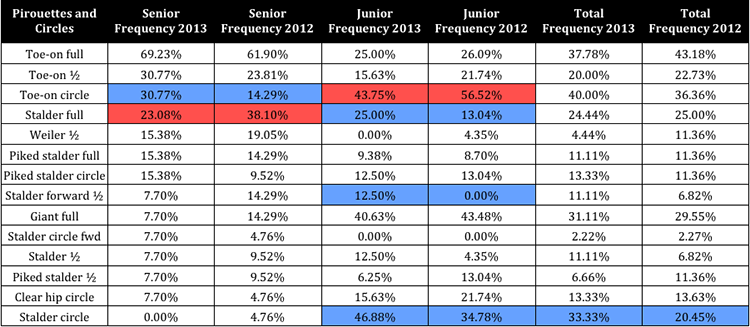
The toe-on full continues to reign as the D pirouetting skill of choice. Even though this code emphasizes release+release combinations, the toe-on full is still a valuable tool connected to a tkatchev or transition for .1 CV.
What's interesting is that the trend favoring toe-on skills over stalder skills seems to be increasing for the seniors, but the opposite is taking place for the juniors. There is a marked increase in the frequency of several of the stalder skills for the juniors. I'm not sure if there is a tangible reason for that, but it's happening. It should be noted that the large majority of those junior stalder fulls might be finishing their turns sometime by the end of the year. Maybe.

So, the Gienger died. That's weird, right? Very abrupt and very dead. The Jaeger just consumed it, apparently. Natural selection. We saw tons of toe-on Tkatchevs this year from the seniors. There are still fewer E releases being performed than I would expect given the new code, but it's early days, and this was not a particularly astounding bars group. They were just happy to get their jaegers in and get out of there.
So, here we go. While you take a break from speculating about McKayla Maroney's bars capabilities and Aliya Mustafina's floor endurance, enjoy some charts. With colors! The colors are supposed to be red and blue, but you never know with me, so if they're actually purple and orange, just deal with it.
As before, the percentages next to the skills indicate the proportion of gymnasts who performed each skill at National Championships, and skills are sorted by the frequency of their appearances in 2013 senior routines. Some basic skills like giant swings and back handsprings are not included because, obviously 100%. Numbers from 2013 and 2012 are listed side-by-side for easy comparison. Cells highlighted in blue reflect an increase in frequency of at least 10 percentage points over 2012, while cells highlighted in red reflect a decrease of at least the same amount. For the most part, any change less than that is statistically insignificant given the small number of routines we're working with (especially for the seniors). Even some of the larger changes may be attributable to normal variation in routine construction rather than code influence, but I'll talk through some of the larger changes as we go.
NOTES: Because there were so many more juniors, the junior routines have a much larger bearing on the total frequency column. Also, the charts include only skills performed during 2013 Nationals. Many skills dropped off the charts from 2012, but none that were performed more than one or two times last year. I didn't do vault because it's fairly straightforward. Yurchenko land. I classified the skills by what was attempted rather than what would actually be credited because this is about intended composition.
UNEVEN BARS
The toe-on full continues to reign as the D pirouetting skill of choice. Even though this code emphasizes release+release combinations, the toe-on full is still a valuable tool connected to a tkatchev or transition for .1 CV.
What's interesting is that the trend favoring toe-on skills over stalder skills seems to be increasing for the seniors, but the opposite is taking place for the juniors. There is a marked increase in the frequency of several of the stalder skills for the juniors. I'm not sure if there is a tangible reason for that, but it's happening. It should be noted that the large majority of those junior stalder fulls might be finishing their turns sometime by the end of the year. Maybe.
So, the Gienger died. That's weird, right? Very abrupt and very dead. The Jaeger just consumed it, apparently. Natural selection. We saw tons of toe-on Tkatchevs this year from the seniors. There are still fewer E releases being performed than I would expect given the new code, but it's early days, and this was not a particularly astounding bars group. They were just happy to get their jaegers in and get out of there.
September 20, 2013
2014 NCAA Schedule
It's almost here, people. Only 3.5 short months away. That's a cup of coffee, really. A cat nap. It's time to start emotionally preparing and deciding how many regrets you're going to have this year. I'm going for maybe something like four. That seems safe.
[ELITE TANGENT] I'm feeling particularly NCAA antsy because we're still over a week away from Worlds, which is forever. Still, the updated women's roster was released today. It's so pitiful. I'm betting right now that the cutoff score for the AA final is lower than the junior qualifying score to US Nationals (51.500). Too harsh? At this rate . . . honestly, the Australians who aren't even going are still in medal contention. Silver lining: an attending Icelander has the last name Odinsdottir. That's awesome. If I were a dottir, I would be taking that name as my own instantly. [/ELITE TANGENT]
But for now, enough NCAA teams have finally released their 2014 schedules that I can put together a composite schedule that is beginning to verge on reliable. We're still waiting on a Tardy Timothy or two to release their schedules (I'm referring to you, Nebraska), and Georgia is being total molasses in getting the meet times out, so keep that in mind. Otherwise, the schedule below should tell you what you need to know about the top teams' seasons.
Oddly, the season is going to false start on the first weekend with only a couple teams competing, which is uncomfortable. It's like during the Olympics when a few events begin before the opening ceremonies. It's just wrong. The actual season won't begin until the 10th of January.
Lots of Saturday meets this season, especially in the Pac-12 as dictated by the TV requirements of the Pac-12 Network. Fortunately for those of us who get the network, many more meets will be on TV this year. Fortunately for those who don't, I'll be my usual live blogging self during all of the good ones, awarding Amanda Borden's hair a 9.825 and maybe talking about the actual gymnastics if there's time. There are also way too many Monday meets for my liking. It's like Stanford's whole schedule.
As usual, the SEC teams have the most challenging schedules because of their conference requirements, and we'll have all the usual mouth-watering match-ups. In particular, circle Alabama hosting Florida on February 28th. Oklahoma's schedule also stands out because, well, look at those road meets. One is the Bart and Nadia Special (which is a home meet in everything but name), two others take place in the state of Texas, and another is in Florida. Those road scores are going to be flying for the Sooners all year long. Don't be remotely surprised by a #1 Oklahoma team for a good chunk of the season.
So, here we go. Some time after Worlds, I'll begin going through the teams and looking at the freshmen to see where they might contribute.
[ELITE TANGENT] I'm feeling particularly NCAA antsy because we're still over a week away from Worlds, which is forever. Still, the updated women's roster was released today. It's so pitiful. I'm betting right now that the cutoff score for the AA final is lower than the junior qualifying score to US Nationals (51.500). Too harsh? At this rate . . . honestly, the Australians who aren't even going are still in medal contention. Silver lining: an attending Icelander has the last name Odinsdottir. That's awesome. If I were a dottir, I would be taking that name as my own instantly. [/ELITE TANGENT]
But for now, enough NCAA teams have finally released their 2014 schedules that I can put together a composite schedule that is beginning to verge on reliable. We're still waiting on a Tardy Timothy or two to release their schedules (I'm referring to you, Nebraska), and Georgia is being total molasses in getting the meet times out, so keep that in mind. Otherwise, the schedule below should tell you what you need to know about the top teams' seasons.
Oddly, the season is going to false start on the first weekend with only a couple teams competing, which is uncomfortable. It's like during the Olympics when a few events begin before the opening ceremonies. It's just wrong. The actual season won't begin until the 10th of January.
Lots of Saturday meets this season, especially in the Pac-12 as dictated by the TV requirements of the Pac-12 Network. Fortunately for those of us who get the network, many more meets will be on TV this year. Fortunately for those who don't, I'll be my usual live blogging self during all of the good ones, awarding Amanda Borden's hair a 9.825 and maybe talking about the actual gymnastics if there's time. There are also way too many Monday meets for my liking. It's like Stanford's whole schedule.
As usual, the SEC teams have the most challenging schedules because of their conference requirements, and we'll have all the usual mouth-watering match-ups. In particular, circle Alabama hosting Florida on February 28th. Oklahoma's schedule also stands out because, well, look at those road meets. One is the Bart and Nadia Special (which is a home meet in everything but name), two others take place in the state of Texas, and another is in Florida. Those road scores are going to be flying for the Sooners all year long. Don't be remotely surprised by a #1 Oklahoma team for a good chunk of the season.
So, here we go. Some time after Worlds, I'll begin going through the teams and looking at the freshmen to see where they might contribute.
Week 0 – January 3-5
Sunday, January 5
2:00 ET/11:00 PT – Penn State @ Iowa State
5:00 ET/2:00 PT – Stanford, San Jose State, UC Davis @ Sacramento State
5:00 ET/2:00 PT – Stanford, San Jose State, UC Davis @ Sacramento State
Week 1 – January
10-12
Friday, January 10
7:00 ET/4:00 PT – Penn State, West Virginia, Ball State @
Kentucky
7:00 ET/4:00 PT – Illinois @ Michigan State
7:30 ET/4:30 PT – Michigan @ Iowa State
7:30 ET/4:30 PT – Michigan @ Iowa State
8:00 ET/5:00 PT – Georgia @ Oklahoma
8:00 ET/5:00 PT – Centenary @ LSU
8:00 ET/5:00 PT – Western Michigan @ Arkansas
8:00 ET/5:00 PT – Texas Woman’s @ Auburn
8:30 ET/5:30 PT – Missouri @ Alabama
Saturday, January 11
4:00 ET/1:00 PT – Oregon State, Bowling Green @ Ohio State
6:00 ET/3:00 PT – Arizona @ UIC
7:00 ET/4:00 PT – Air Force, Lindenwood @ Minnesota
7:00 ET/4:00 PT – Northern Illinois @ Nebraska
8:00 ET/5:00 PT – Cal @ Denver
9:00 ET/6:00 PT – Boise State, Southern Utah, BYU @ Utah
8:00 ET/5:00 PT – Cal @ Denver
9:00 ET/6:00 PT – Boise State, Southern Utah, BYU @ Utah
10:00 ET/7:00 PT – Florida @ UCLA
Sunday, January 12
5:00 ET/2:00 PT – Georgia @ Stanford
Monday, January 13
10:00 ET/7:00 PT – Minnesota @ Washington
September 15, 2013
US World Team
Some brief thoughts.
The US World team is as follows: Kyla Ross (obvio), Simone Biles (obvio), McKayla Maroney (triple obvio), and Brenna Dowell (okay. . . ).
The non-traveling alternate is Elizabeth Price. No traveling alternate was named, but let's be honest, it's Brenna Dowell. I imagine that was the main thought process behind her selection to the team. She was 3rd in the AA at Nationals, and if Maroney and Price aren't up to the task (as they weren't at Nationals), it appears she is the #3 AAer in the country right now. Therefore, she can step into an AA role if someone gets injured and be a legitimate participant. As it currently stands with her as the UB and BB specialist, she won't get a sniff at beam. It's not out of the question that she could pop into a bars final given the lack of depth going to Worlds from all the countries. However, she would have to outscore Biles in qualification to get a US spot (assuming Kyla scores in the 15s, which neither of the others can do). That's not a given. When we're comparing them to Ross, Mustafina, and the Chinese, both Biles and Dowell are well below that level.
The interesting thing is that what we've seen from Dowell is less competitive on bars than a healthy Elizabeth Price in both difficulty and execution, which is why I think her selection was mostly a Martha "meh, it has to be someone" selection. In the past, Martha has shown an intense willingness to fill out possibly questionable spots on teams with the next best AAer who can jump into any role if necessary. Dowell basically got the Peszek spot on this team, even though it isn't a team worlds so that doesn't make sense. I had Price as my pick going in, figuring that none of the non-locks are that internationally competitive on beam and Price has the highest potential of the rest on bars, so I'm wondering if perhaps a lack of full AA difficulty or training time made Martha loath to select her for the team, knowing as we do how Martha loves people to have proved their consistency 1500 million times in a row before making a team.
The US World team is as follows: Kyla Ross (obvio), Simone Biles (obvio), McKayla Maroney (triple obvio), and Brenna Dowell (okay. . . ).
The non-traveling alternate is Elizabeth Price. No traveling alternate was named, but let's be honest, it's Brenna Dowell. I imagine that was the main thought process behind her selection to the team. She was 3rd in the AA at Nationals, and if Maroney and Price aren't up to the task (as they weren't at Nationals), it appears she is the #3 AAer in the country right now. Therefore, she can step into an AA role if someone gets injured and be a legitimate participant. As it currently stands with her as the UB and BB specialist, she won't get a sniff at beam. It's not out of the question that she could pop into a bars final given the lack of depth going to Worlds from all the countries. However, she would have to outscore Biles in qualification to get a US spot (assuming Kyla scores in the 15s, which neither of the others can do). That's not a given. When we're comparing them to Ross, Mustafina, and the Chinese, both Biles and Dowell are well below that level.
The interesting thing is that what we've seen from Dowell is less competitive on bars than a healthy Elizabeth Price in both difficulty and execution, which is why I think her selection was mostly a Martha "meh, it has to be someone" selection. In the past, Martha has shown an intense willingness to fill out possibly questionable spots on teams with the next best AAer who can jump into any role if necessary. Dowell basically got the Peszek spot on this team, even though it isn't a team worlds so that doesn't make sense. I had Price as my pick going in, figuring that none of the non-locks are that internationally competitive on beam and Price has the highest potential of the rest on bars, so I'm wondering if perhaps a lack of full AA difficulty or training time made Martha loath to select her for the team, knowing as we do how Martha loves people to have proved their consistency 1500 million times in a row before making a team.
September 1, 2013
A Post about Nothing

Why do such large portions of the gymnastics season insist on being so deeply boring? And then just when we get going - oops, boring again. The US elites are all away in their cupboards under the stairs preparing for their field trip to Six Flags Magic Martha, and the Russians are all made of rice paper and disappointment as usual. BUH. It's not like it will even get much better once selection camp begins because the only conversation is about who will sneak into that filler fourth spot to make up the numbers. The verification for that spot should just be a moving mats and getting water obstacle course. Actually, I would watch that. Note to USAG.
Honestly, I have come around to favoring the US sending a team of three AAers. It will never ever happen because of inevitable claims of unfairness from the other coaches and because of perception issues. Romania is sending just three, and when the team registrations first revealed that information, the prevailing reaction was "Oh, look how feeble Romania's program is now. They can't even come up with four gymnasts to send to worlds." The US would never risk that.
This boredom issue is why NCAA is so much less frustrating than elite. The season begins, and then there's always something happening. NCAA is at least a little concerned about not boring us with lulls. Speaking of, I've noticed on the 2014 schedules that this is one of those seasons where the first weekend in January falls too close to the first, so everyone is beginning the season during the second weekend in January. Championships, however, is still at the same time as always, so the overall season is one week shorter. This means quite a few teams have scheduled no bye weeks between the start of the season and conference championships, so the choices about resting the fragile will be something to watch.
While we're on NCAA, there's a new site going around called road to nationals with some handy charty charts that must have taken damn forever to create and that will make synthesizing information much faster for those of us who like to fill preseason time with NCAA statistical analysis.
Finally, I would like to register my severe disappointment with a number of NCAA programs for completely overhauling their athletic websites since the end of last season. Now I have to go through and change all my bookmarks. Incredibly inconsiderate. Sometimes, I almost feel like other people don't have my convenience constantly in mind. We must address this problem as a nation.
That's all.
Subscribe to:
Posts (Atom)