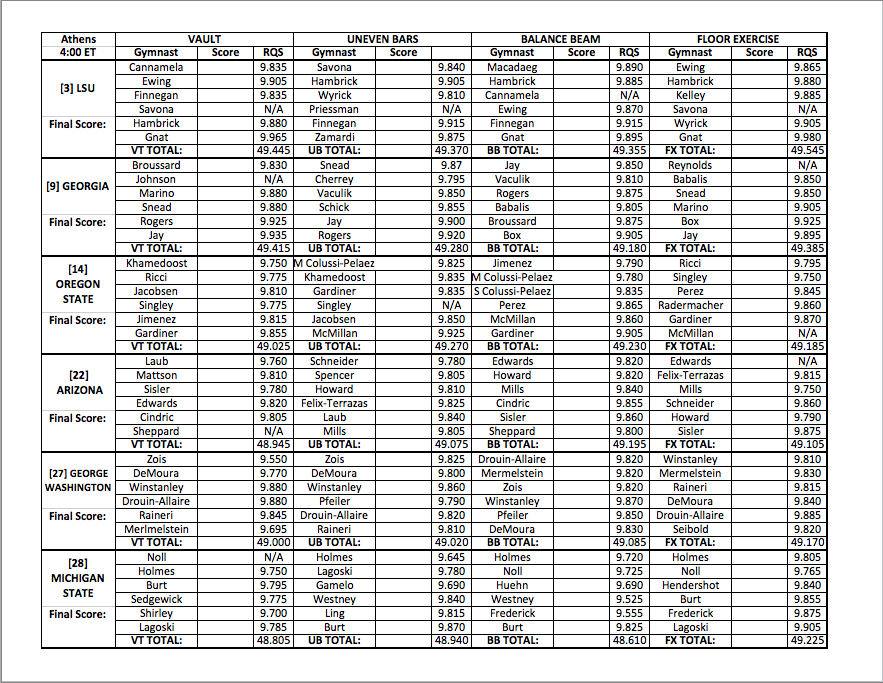
It's regionals day! The one day every year where your biggest problem is the decision whether to dedicate your phone to one of the competitions streams or put that pressure on your computer with a extra browser window and risk a critical-mass rebellion. It's a really rough life. We probably need a charity. Or at least a hashtag. #prayforgymfans
Regionals headquarters with all the info is here, but these are the highlights:
4:00 ET/1:00 PT – Athens, GA – Scores - Stream
5:00 ET/2:00 PT – Iowa City, IA – Scores - Stream - Stream (vault) - Steam (bars) - Stream (beam) - Stream (floor)
5:00 ET/2:00 PT – Minneapolis, MN – Scores - Stream
5:00 ET/2:00 PT – Tuscaloosa, AL – Scores - Stream
6:00 ET/3:00 PT – Ann Arbor, MI – Scores - Stream
8:00 ET/5:00 PT – Salt Lake City, UT – Scores - Stream - Stream (vault) - Stream (bars) - Stream (beam) - Stream (floor)
After all these months, today is also the first time all season that results actually matter! Hooray! In a few short (long) hours, 36 becomes 12. Top two or bust! You know, that famous goal all athletes have. Clear eyes, full hearts, can finish second and still advance.
The hope for today is that someone, somewhere will pull off some manner of upset. After the top 12 all advanced to nationals last season, we earned something a little more fun. One teensy little meltdown doesn't seem like too much to ask. Put in your upset predictions now, so that you can be showered with praise when it happens.
The day will start slowly, which is charitable, but it will become nightmarish pretty quickly. We will invariably start missing things in hour two, when a number of the crucial bubble teams will all be on beam. Nebraska, Denver, and Cal's beam rotations will all determine quite a lot about what the #3 seeds will (or will not) have to do to score the much-anticipated upset.
Showing posts with label Regionals. Show all posts
April 2, 2016
April 1, 2016
Regional Championship Headquarters
Tomorrow, you will all be compelled to participate in the annual gymnastics tradition that is Ironman Regionals. It's seven straight hours of frenetic gymnastics watching, multitasking-based panic attacks, third-person auditory hallucinations, spontaneous Miss Val impressions, alcoholism, narcolepsy, uncontrollable blindness spells, dislocated bladders, and ultimately acceptance, during which you will need to commandeer all adjacent devices while clinging to the pipe dream that you'll actually be paying attention at the right time when something important happens.
As part of that pipe dream, I've put together my annual combined rotation schedule for all the meets, providing a rough estimate of when each team should be competing on each event for all your circling and highlighting and browser-window-prioritization needs. I allow 30 minutes per rotation, which usually ends up being close to accurate in most locations because of all the marching and the waiting and the byes. Oh god, the byes. There's always a location or two that ends up slow as molasses for no reason and gets behind schedule, but this should be a relatively close overview of the timing.
Yeah, Oklahoma, Florida, Alabama, Michigan, and Oregon State are all on beam at the same time. This is well planned. 6:00-7:00 ET is going to be a hellscape.
And now...the meets! Here's everything you could possible need to know. I'll add links as they become available. Teams have not been on top of it with the scoring links so far...
2016 Regional Championships
4:00 ET/1:00 PT – Athens, GA Regional
[3] LSU, [9] Georgia, [14] Oregon State, [22] Arizona, [27] George Washington, [36] Michigan State
Preview
Live scores
Live stream
Score sheet/projected lineups/RQSs:

5:00 ET/2:00 PT – Iowa City, IA Regional
[1] Oklahoma, [12] Nebraska, [13] Arkansas, [19] Iowa, [30] Kent State, [35] Central Michigan
Preview
Live scores
Live stream (four-event view)
Live stream (vault)
Live stream (bars)
Live stream (beam)
Live stream (floor)
Score sheet/projected lineups/RQSs:

5:00 ET/2:00 PT – Minneapolis, MN Regional
[2] Florida, [11] Denver, [16] Minnesota, [20] Missouri, [28] Ohio State, [31] BYU
Preview
Live scores
Live stream
Score sheet/projected lineups/RQSs:

5:00 ET/2:00 PT – Tuscaloosa, AL Regional
[4] Alabama, [10] Cal, [15] Boise State, [21] Kentucky, [26] West Virginia, [34] Bowling Green
Preview
Live scores
Live stream
Score sheet/projected lineups/RQSs:

6:00 ET/3:00 PT – Ann Arbor, MI Regional
[6] Auburn, [7] Michigan, [18] Stanford, [24] Eastern Michigan, [25] Penn State, [33] New Hampshire
Preview
Live scores
Live stream
Score sheet/projected lineups/RQSs:

8:00 ET/5:00 PT – Salt Lake City, UT Regional
[5] Utah, [8] UCLA, [17] Washington, [23] Southern Utah, [29] Illinois, [32] Utah State
Preview
Live scores
Live stream
Live stream (vault)
Live stream (bars)
Live stream (beam)
Live stream (floor)
Score sheet/projected lineups/RQSs:

As part of that pipe dream, I've put together my annual combined rotation schedule for all the meets, providing a rough estimate of when each team should be competing on each event for all your circling and highlighting and browser-window-prioritization needs. I allow 30 minutes per rotation, which usually ends up being close to accurate in most locations because of all the marching and the waiting and the byes. Oh god, the byes. There's always a location or two that ends up slow as molasses for no reason and gets behind schedule, but this should be a relatively close overview of the timing.
Yeah, Oklahoma, Florida, Alabama, Michigan, and Oregon State are all on beam at the same time. This is well planned. 6:00-7:00 ET is going to be a hellscape.
And now...the meets! Here's everything you could possible need to know. I'll add links as they become available. Teams have not been on top of it with the scoring links so far...
2016 Regional Championships
4:00 ET/1:00 PT – Athens, GA Regional
[3] LSU, [9] Georgia, [14] Oregon State, [22] Arizona, [27] George Washington, [36] Michigan State
Preview
Live scores
Live stream
Score sheet/projected lineups/RQSs:

5:00 ET/2:00 PT – Iowa City, IA Regional
[1] Oklahoma, [12] Nebraska, [13] Arkansas, [19] Iowa, [30] Kent State, [35] Central Michigan
Preview
Live scores
Live stream (four-event view)
Live stream (vault)
Live stream (bars)
Live stream (beam)
Live stream (floor)
Score sheet/projected lineups/RQSs:

5:00 ET/2:00 PT – Minneapolis, MN Regional
[2] Florida, [11] Denver, [16] Minnesota, [20] Missouri, [28] Ohio State, [31] BYU
Preview
Live scores
Live stream
Score sheet/projected lineups/RQSs:

5:00 ET/2:00 PT – Tuscaloosa, AL Regional
[4] Alabama, [10] Cal, [15] Boise State, [21] Kentucky, [26] West Virginia, [34] Bowling Green
Preview
Live scores
Live stream
Score sheet/projected lineups/RQSs:

6:00 ET/3:00 PT – Ann Arbor, MI Regional
[6] Auburn, [7] Michigan, [18] Stanford, [24] Eastern Michigan, [25] Penn State, [33] New Hampshire
Preview
Live scores
Live stream
Score sheet/projected lineups/RQSs:

8:00 ET/5:00 PT – Salt Lake City, UT Regional
[5] Utah, [8] UCLA, [17] Washington, [23] Southern Utah, [29] Illinois, [32] Utah State
Preview
Live scores
Live stream
Live stream (vault)
Live stream (bars)
Live stream (beam)
Live stream (floor)
Score sheet/projected lineups/RQSs:

March 31, 2016
Michigan Regional Preview
Here it is. The big one. Are you excited? I'm excited. Ever since it became clear that Stanford's ranking would not emerge from the pitiful category before the end of the season, we've all been waiting to see which of the poor souls that bothered to get good scores all year long would suffer the punishment of being placed with Stanford. The winners are Auburn and Michigan. It's funny because the 6-7-18 regional is usually the boring one, the one where the top two teams have more than a fall of margin over anyone else, but this year, it's the one everyone is anticipating the most. Yes, I just decided which regional you're anticipating the most. It's this. The end.
Of course, that means it will end up being super boring. Without a doubt. It always happens. All of the other regionals will be intensely close throughout, and then this one will be decided in the first rotation. You know it.
Competing teams (starting event)
[6] Auburn (bye before bars)
[7] Michigan (beam)
[18] Stanford (floor)
[24] Eastern Michigan (bye before floor)
[25] Penn State (bars)
[33] New Hampshire (vault)
Competing individuals
Pittsburgh (Lindsay Offutt – AA; Tracey Pearson – AA; Miya Dotson – UB)
Rutgers (Libby Groden – AA; Nicolette Wilson – VT; Michelle Amoresano – VT)
Bridgeport (Brianna Comport – BB, FX; Christine Liautaud – UB; Randi Cutolo – FX)
West Chester (Majesta Valentine – AA)
Cornell (Kaitlin Green – BB)
The fight – Auburn v. Michigan v. Stanford
No favorites here. There can't be because someone very capable of a 197 will miss out on nationals, and any one of these three teams could be eliminated even with a hit meet.
Still, Stanford must be considered the challenger to the throne rather than the reigning monarch because of a few more clear weaknesses than the others and the lack of consistently competitive scores during the season. In spite of Stanford's definite potential to hit 197 and reputation for suddenly turning great once the elimination meets roll around, there's a reason Stanford is 18th and not 6th or 7th. The scores haven't been there the way they have for Auburn and Michigan, and Stanford really will have to put together a season-best performance to make it out of this competition. Normal won't be good enough. It has to be a Price/Hong 9.950, Rice/McNair 9.850 kind of day to pull out the 197+ score it will take to advance.
Auburn and Michigan are separated by essentially nothing. Auburn is a wisp ahead of Michigan in overall RQS, while Michigan is a wisp ahead of Auburn on each specific-event RQS. That indicates that Michigan has slightly higher peaks on each event but that Auburn has put it all together in the same meet slightly more often. It's all slight. The advantage of being at home may tip the balance to Michigan, which is why (in addition to Michigan's season high being the best in the competition) I see Auburn as more vulnerable than Michigan if both hit their meets. Really, there should only be a tenth or two between them either way.
Ergo...landings, landings, landings. On vault, for instance, Michigan has more difficulty, and the Olivia Karas grand finale has scored higher than the Caitlin Atkinson grand finale, but we have seen multiple meets this year in which Auburn has earned a very competitive vault score because of high-level landing control. Since Michigan's peak scoring potential has been higher this year, those landings are all the more important for Auburn to close any scoring potential gap.
For both teams, the vulnerability is beam. In fact, it has been a vulnerability for Stanford at times as this year well (but will be absolutely critical if Stanford is to stay in this), all of which is made evident by New Hampshire being ranked as the #2 beam team in this regional. Each of these top seeds has the potential for multiple 9.9s. Atkinson, Milliet, Demers, Artz, Chiarelli, Price, Hong. There's no shortage of impressive beamers in this meet, but Auburn has a tendency to throw a 9.7 or two out there early in the lineup, and Michigan has been a sudden fall-fest in the second half of the season. Beam will be the most telling indicator about whether Stanford is in this meet because secure hits from both Michigan and Auburn (in rotations one and three) would take away the primary area in which Stanford is looking to pick up tenths (in rotation five).
Of course, that means it will end up being super boring. Without a doubt. It always happens. All of the other regionals will be intensely close throughout, and then this one will be decided in the first rotation. You know it.
Competing teams (starting event)
[6] Auburn (bye before bars)
[7] Michigan (beam)
[18] Stanford (floor)
[24] Eastern Michigan (bye before floor)
[25] Penn State (bars)
[33] New Hampshire (vault)
Competing individuals
Pittsburgh (Lindsay Offutt – AA; Tracey Pearson – AA; Miya Dotson – UB)
Rutgers (Libby Groden – AA; Nicolette Wilson – VT; Michelle Amoresano – VT)
Bridgeport (Brianna Comport – BB, FX; Christine Liautaud – UB; Randi Cutolo – FX)
West Chester (Majesta Valentine – AA)
Cornell (Kaitlin Green – BB)
The fight – Auburn v. Michigan v. Stanford
No favorites here. There can't be because someone very capable of a 197 will miss out on nationals, and any one of these three teams could be eliminated even with a hit meet.
Still, Stanford must be considered the challenger to the throne rather than the reigning monarch because of a few more clear weaknesses than the others and the lack of consistently competitive scores during the season. In spite of Stanford's definite potential to hit 197 and reputation for suddenly turning great once the elimination meets roll around, there's a reason Stanford is 18th and not 6th or 7th. The scores haven't been there the way they have for Auburn and Michigan, and Stanford really will have to put together a season-best performance to make it out of this competition. Normal won't be good enough. It has to be a Price/Hong 9.950, Rice/McNair 9.850 kind of day to pull out the 197+ score it will take to advance.
Auburn and Michigan are separated by essentially nothing. Auburn is a wisp ahead of Michigan in overall RQS, while Michigan is a wisp ahead of Auburn on each specific-event RQS. That indicates that Michigan has slightly higher peaks on each event but that Auburn has put it all together in the same meet slightly more often. It's all slight. The advantage of being at home may tip the balance to Michigan, which is why (in addition to Michigan's season high being the best in the competition) I see Auburn as more vulnerable than Michigan if both hit their meets. Really, there should only be a tenth or two between them either way.
Ergo...landings, landings, landings. On vault, for instance, Michigan has more difficulty, and the Olivia Karas grand finale has scored higher than the Caitlin Atkinson grand finale, but we have seen multiple meets this year in which Auburn has earned a very competitive vault score because of high-level landing control. Since Michigan's peak scoring potential has been higher this year, those landings are all the more important for Auburn to close any scoring potential gap.
For both teams, the vulnerability is beam. In fact, it has been a vulnerability for Stanford at times as this year well (but will be absolutely critical if Stanford is to stay in this), all of which is made evident by New Hampshire being ranked as the #2 beam team in this regional. Each of these top seeds has the potential for multiple 9.9s. Atkinson, Milliet, Demers, Artz, Chiarelli, Price, Hong. There's no shortage of impressive beamers in this meet, but Auburn has a tendency to throw a 9.7 or two out there early in the lineup, and Michigan has been a sudden fall-fest in the second half of the season. Beam will be the most telling indicator about whether Stanford is in this meet because secure hits from both Michigan and Auburn (in rotations one and three) would take away the primary area in which Stanford is looking to pick up tenths (in rotation five).
March 30, 2016
Utah Regional Preview
Welcome to Pac-12s Part Deux: Megan's Revenge, the thrilling summer blockbuster in which Utah will try to beat UCLA for the first time in 2016 following two consecutive losses in what feels like their fifteenth meeting of the season.
Repetitive matchups are one of the problems I have with creating a bracket for the postseason, in addition to the fact that it's not a true knockout event and doesn't have enough rounds for a bracket to be all that necessary. (It should be a true knockout event, but it isn't. The meets are best 2 out of 6, or 3 out of 6, which isn't the same thing and is fundamentally less dramatic. You don't get a bracket until you institute a format that lends itself to a bracket. You don't get dessert until you eat your vegetables.) You might as well just list all the teams at the beginning of the season in two columns, put a box in the middle for the winner, and say, "It's a bracket!" It's not a bracket.
This will be the third meeting of the season between Utah and UCLA (and their third each against Washington, though at least they were in different sessions at Pac-12s). If they both do qualify, the semifinals will be their 4th meeting and the third consecutive meet day in which they've faced off. We get it. By contrast, Utah and Auburn would have been an interesting comparison, and they probably won't meet at all.
Competing teams (starting event)
[5] Utah (bye before bars)
[8] UCLA (beam)
[17] Washington (floor)
[23] Southern Utah (bye before floor)
[29] Illinois (bars)
[32] Utah State (vault)
Competing individuals
Sacramento State (Kalliah McCartney – AA; Lauren Rice – AA; Cassie Benning – UB, FX; Julia Konner – VT)
UC Davis (Alexis Brown – UB, BB; Stephanie Stamates – BB, FX; Katy Nogaki – VT)
Seattle Pacific (Maria Hundley – AA)
Alaska (M'rcy Matsunami – AA)
The favorites – Utah and UCLA
Unlike in the regionals previewed so far, this one features two teams that really should go through barring disaster. Disasters are always possible, and always the most fun, but if Utah and UCLA hit five-for-six on each event, they'll advance. The other teams are hoping for a mistake.
The clash between Utah and UCLA should still be quite interesting and telling about both teams' potential to do some damage in the postseason. UCLA's position is bolstered by the two wins over Utah this year, while Utah's position is bolstered by finishing only .325 behind UCLA at Pac-12s in spite of counting a fall. And by being at home this time. The Bruins would counter that they also had some mistakes at Pac-12s that brought down their score, like Cipra's floor fall and Preston's not-in-the-face vault. And we could go on. It should be a close-fought affair. With the home advantage and the stronger scoring pedigree over the whole season (a higher RQS on three of four events), Utah should come in as the favorite between the two, though far from a prohibitive one.
Neither team has a ton of difficulty on vault and both may struggle to compete with the three-1.5 lineups of the SEC once we get to nationals, but Utah's landings were significantly stronger than UCLA's at Pac-12s with a couple vaulters showing season-best sticks. Even without a difficulty edge, Utah's vault beat UCLA's by nearly three tenths because of landings (and direction, and knees), which would be a massive boon if that were repeated at regionals.
UCLA's edge comes on beam, with a lineup that is quite smooth in rhythm, precise in split elements, and varied in skill selection and difficulty. Utah, meanwhile, showed the signs of the Stover-ectomy in counting a beam fall at Pac-12s. It's clear the team needs her back as soon as possible not just to prevent using a fall but to provide a much-needed 9.9.
Interestingly, UCLA beat Utah on bars at Pac-12s, even though bars is supposed to be a weakness for UCLA that compromises postseason hopes while it has been a strength for Utah. If UCLA is able to continue minimizing the bars deficit compared to a team like Utah, perhaps aided by a mysterious secret-weapon appearance of Peng or Ohashi, that would eliminate one major obstacle to postseason success. I'm not convinced yet, but it will be worth watching.
As for the rotation order, UCLA begins on its two best events, which I don't love. It means the Bruins must get a bunch of big scores early and absolutely need a lead at the halfway point, and a pretty significant one, to have a shot at winning this thing. They'll want a solid 98.800 after beam and floor, which is doable. The Utes will gain ground in the second half of the meet, particularly when they turn to floor as UCLA is turning to vault. As long as Utah is anywhere over 98.500 after bars and beam, even if still trailing, I would consider that on track to put up a competitive total/win.
Repetitive matchups are one of the problems I have with creating a bracket for the postseason, in addition to the fact that it's not a true knockout event and doesn't have enough rounds for a bracket to be all that necessary. (It should be a true knockout event, but it isn't. The meets are best 2 out of 6, or 3 out of 6, which isn't the same thing and is fundamentally less dramatic. You don't get a bracket until you institute a format that lends itself to a bracket. You don't get dessert until you eat your vegetables.) You might as well just list all the teams at the beginning of the season in two columns, put a box in the middle for the winner, and say, "It's a bracket!" It's not a bracket.
This will be the third meeting of the season between Utah and UCLA (and their third each against Washington, though at least they were in different sessions at Pac-12s). If they both do qualify, the semifinals will be their 4th meeting and the third consecutive meet day in which they've faced off. We get it. By contrast, Utah and Auburn would have been an interesting comparison, and they probably won't meet at all.
Competing teams (starting event)
[5] Utah (bye before bars)
[8] UCLA (beam)
[17] Washington (floor)
[23] Southern Utah (bye before floor)
[29] Illinois (bars)
[32] Utah State (vault)
Competing individuals
Sacramento State (Kalliah McCartney – AA; Lauren Rice – AA; Cassie Benning – UB, FX; Julia Konner – VT)
UC Davis (Alexis Brown – UB, BB; Stephanie Stamates – BB, FX; Katy Nogaki – VT)
Seattle Pacific (Maria Hundley – AA)
Alaska (M'rcy Matsunami – AA)
The favorites – Utah and UCLA
Unlike in the regionals previewed so far, this one features two teams that really should go through barring disaster. Disasters are always possible, and always the most fun, but if Utah and UCLA hit five-for-six on each event, they'll advance. The other teams are hoping for a mistake.
The clash between Utah and UCLA should still be quite interesting and telling about both teams' potential to do some damage in the postseason. UCLA's position is bolstered by the two wins over Utah this year, while Utah's position is bolstered by finishing only .325 behind UCLA at Pac-12s in spite of counting a fall. And by being at home this time. The Bruins would counter that they also had some mistakes at Pac-12s that brought down their score, like Cipra's floor fall and Preston's not-in-the-face vault. And we could go on. It should be a close-fought affair. With the home advantage and the stronger scoring pedigree over the whole season (a higher RQS on three of four events), Utah should come in as the favorite between the two, though far from a prohibitive one.
Neither team has a ton of difficulty on vault and both may struggle to compete with the three-1.5 lineups of the SEC once we get to nationals, but Utah's landings were significantly stronger than UCLA's at Pac-12s with a couple vaulters showing season-best sticks. Even without a difficulty edge, Utah's vault beat UCLA's by nearly three tenths because of landings (and direction, and knees), which would be a massive boon if that were repeated at regionals.
UCLA's edge comes on beam, with a lineup that is quite smooth in rhythm, precise in split elements, and varied in skill selection and difficulty. Utah, meanwhile, showed the signs of the Stover-ectomy in counting a beam fall at Pac-12s. It's clear the team needs her back as soon as possible not just to prevent using a fall but to provide a much-needed 9.9.
Interestingly, UCLA beat Utah on bars at Pac-12s, even though bars is supposed to be a weakness for UCLA that compromises postseason hopes while it has been a strength for Utah. If UCLA is able to continue minimizing the bars deficit compared to a team like Utah, perhaps aided by a mysterious secret-weapon appearance of Peng or Ohashi, that would eliminate one major obstacle to postseason success. I'm not convinced yet, but it will be worth watching.
As for the rotation order, UCLA begins on its two best events, which I don't love. It means the Bruins must get a bunch of big scores early and absolutely need a lead at the halfway point, and a pretty significant one, to have a shot at winning this thing. They'll want a solid 98.800 after beam and floor, which is doable. The Utes will gain ground in the second half of the meet, particularly when they turn to floor as UCLA is turning to vault. As long as Utah is anywhere over 98.500 after bars and beam, even if still trailing, I would consider that on track to put up a competitive total/win.
March 29, 2016
Alabama Regional Preview
While several of the regionals this year could produce an unexpected nationals qualifier that we will pretend signals the beginning of a new era until next season when everything returns to normal, the most exciting changing of the guard will happen in Alabama. Though some of the challengers elsewhere, like Denver and Minnesota, haven't qualified to nationals for a few years, the teams in this regional have been stranded in the desert for much, much longer. Cal has been absent from the national championship since 1992, and Boise State and Kentucky have been absent since always. In fact, with three all-time nationals appearances, #5 seed West Virginia is the second-most accomplished team in the competition.
Competing teams (starting event)
[4] Alabama (bye before bars)
[10] Cal (beam)
[15] Boise State (floor)
[21] Kentucky (bye before floor)
[26] West Virginia (bars)
[34] Bowling Green (vault)
Competing individuals
SEMO (Alexis Brawner – AA; Lauren Israel – AA; McKinzie Jones – FX)
Northern Illinois (Andie Van Voorhis – VT; Jamyra Carter – UB; Lauren Africano – UB; Megan Greenfield – BB)
Arizona State (Allie Salas – AA; Taylor Allex – VT, FX)
Illinois-Chicago (Mikailla Northern – AA)
Illinois State (Amanda Mohler – BB)
The favorite – Alabama
Alabama is Alabama. Competing at home against a relatively unheralded squadron of challengers and coming off an impressive second-place showing at SECs should really be all we need to know about Alabama's qualification outlook. Coleman may no longer the impenetrable home fortress it once was, now the site of previously unheard of losses to LSU and Arkansas, but the idea of Alabama getting upset at home by two whole teams in this meet is difficult to fathom.
Unsurprisingly, Alabama had its best meet of the season at SECs, which happened to coincide with actually getting all the good people in the lineups simultaneously for the first time. Amazing how that works out. Winston returned on three events, all the top-scoring floor workers competed, and Bresette was able to show her Omelianchik, which is a higher-scoring option than her full. All of this combined to make Alabama look like a peer of Oklahoma, Florida, and LSU in the title race rather than the leader of the challenging pack. These lineups still don't look fully finalized (you can't quit depth exploration cold turkey), as I'd still perhaps like to see Winston vaulting and, critically, that was not the highest-scoring beam lineup Alabama could put out. Sanders did an excellent job of suddenly being a gymnast now, but hit routines from Beers and Bailey are going to score higher than what she (and potentially Brannan) can bring.
It's an issue of hitting (both Bailey and Beers fell the week before), but if the coaches feel comfortable putting Bailey and Beers in the lineup, this team looks more formidable and closer to 198. If not, Alabama may be giving up a crucial tenth or two on beam, the rotation that knocked them down below Florida's at SECs.
The fight – Cal v. Boise State
This meet represents a brand new phenomenon for Cal. We've seen Cal perform well in significant meets against strong teams over the last three seasons, but for the first time I can remember, Cal will enter a significant meet not as an upstart, or an underdog, or a spoiler, or a sentimental favorite but as a favorite. Cal should finish second here and should qualify along with Alabama. Not doing so would be a disappointing result given the wonderful opportunity to make nationals presented before them. Welcome to expectations, Cal. It's nice to have you here.
That's not to say it's going to be a walk. Boise State has been in many ways the surprise of the season (after being the punchline of the preseason when one coach voted BSU #1), scoring a 197.025 at conference championships—at home—which bested the 196.725 Cal put up at Pac-12s. Boise State does, however, remain the least proven entity among the contending teams, having gone the whole season without facing any school seeded 1-3 in any of the regionals. We don't really know how these routines are going to be evaluated when Boise State is suddenly not the biggest and the best in the arena for the first time. The Broncos' last challenging road meet also came at Alabama, in 2015, when they did prove quite competitive through three events and were on high-196 pace until a floor meltdown.
Competing teams (starting event)
[4] Alabama (bye before bars)
[10] Cal (beam)
[15] Boise State (floor)
[21] Kentucky (bye before floor)
[26] West Virginia (bars)
[34] Bowling Green (vault)
Competing individuals
SEMO (Alexis Brawner – AA; Lauren Israel – AA; McKinzie Jones – FX)
Northern Illinois (Andie Van Voorhis – VT; Jamyra Carter – UB; Lauren Africano – UB; Megan Greenfield – BB)
Arizona State (Allie Salas – AA; Taylor Allex – VT, FX)
Illinois-Chicago (Mikailla Northern – AA)
Illinois State (Amanda Mohler – BB)
The favorite – Alabama
Alabama is Alabama. Competing at home against a relatively unheralded squadron of challengers and coming off an impressive second-place showing at SECs should really be all we need to know about Alabama's qualification outlook. Coleman may no longer the impenetrable home fortress it once was, now the site of previously unheard of losses to LSU and Arkansas, but the idea of Alabama getting upset at home by two whole teams in this meet is difficult to fathom.
Unsurprisingly, Alabama had its best meet of the season at SECs, which happened to coincide with actually getting all the good people in the lineups simultaneously for the first time. Amazing how that works out. Winston returned on three events, all the top-scoring floor workers competed, and Bresette was able to show her Omelianchik, which is a higher-scoring option than her full. All of this combined to make Alabama look like a peer of Oklahoma, Florida, and LSU in the title race rather than the leader of the challenging pack. These lineups still don't look fully finalized (you can't quit depth exploration cold turkey), as I'd still perhaps like to see Winston vaulting and, critically, that was not the highest-scoring beam lineup Alabama could put out. Sanders did an excellent job of suddenly being a gymnast now, but hit routines from Beers and Bailey are going to score higher than what she (and potentially Brannan) can bring.
It's an issue of hitting (both Bailey and Beers fell the week before), but if the coaches feel comfortable putting Bailey and Beers in the lineup, this team looks more formidable and closer to 198. If not, Alabama may be giving up a crucial tenth or two on beam, the rotation that knocked them down below Florida's at SECs.
The fight – Cal v. Boise State
This meet represents a brand new phenomenon for Cal. We've seen Cal perform well in significant meets against strong teams over the last three seasons, but for the first time I can remember, Cal will enter a significant meet not as an upstart, or an underdog, or a spoiler, or a sentimental favorite but as a favorite. Cal should finish second here and should qualify along with Alabama. Not doing so would be a disappointing result given the wonderful opportunity to make nationals presented before them. Welcome to expectations, Cal. It's nice to have you here.
That's not to say it's going to be a walk. Boise State has been in many ways the surprise of the season (after being the punchline of the preseason when one coach voted BSU #1), scoring a 197.025 at conference championships—at home—which bested the 196.725 Cal put up at Pac-12s. Boise State does, however, remain the least proven entity among the contending teams, having gone the whole season without facing any school seeded 1-3 in any of the regionals. We don't really know how these routines are going to be evaluated when Boise State is suddenly not the biggest and the best in the arena for the first time. The Broncos' last challenging road meet also came at Alabama, in 2015, when they did prove quite competitive through three events and were on high-196 pace until a floor meltdown.
March 28, 2016
Georgia Regional Preview
A quick glance at Saturday's schedule reveals that regionals have been planned even more horrifically than usual this year. There will be a point during the day at which five of the six competitions will be occurring simultaneously, mostly because they hate us and want us to miss everything. And by they, I mean the people. The people who do the things. Spread the regionals throughout the day, is all I ask. The silver lining to all of this is that Georgia's regional begins an hour before all the others, and Georgia starts on beam. That means we can watch that entire emotional roller coaster unfold without distraction. Thank you, Georgia, for your time zone.
Competing teams (starting event)
[3] LSU (bye before bars)
[9] Georgia (beam)
[14] Oregon State (floor)
[22] Arizona (bye before floor)
[27] George Washington (bars)
[36] Michigan State (vault)
Competing individuals
NC State (Brittni Watkins – AA; Chelsea Knight – VT; Nicole Wild – BB)
Maryland (Kathy Tang – VT, FX; Abbie Epperson – UB; Macey Roberts – FX)
North Carolina (Morgan Lane – AA; Kaitlynn Hedelund – UB)
Towson (Tyra McKellar – AA; Mary Elle Arduino – BB)
William & Mary (Brittany Stover – AA)
The favorite – LSU
LSU should join Oklahoma and Florida at the same level of heavy, heavy, super favorites to advance from regionals, though the Tigers may feel a little more pressure in this one given the quality of the opposition and the scoring pedigree shown by Georgia and Oregon State, both historically and lately. This competition features the second-deepest collection of 1-2-3 seeds (behind the Michigan regional), so LSU will not be able to afford any mind-losing on beam. These other teams are too capable of taking advantage. Sans any mind-losing and fall-counting, however, LSU will slide through to nationals without forcing DD to punishment-sequin anyone.
The Tigers should have been right in the hunt for the SEC title this year but ended up a step behind Florida and Alabama entirely because of their performance on bars in the first rotation. In fact, if you take the scores from just vault, beam, and floor, LSU wins the competition. Lucky, lucky LSU, they'll be starting on bars at regionals. You're welcome. This LSU bars lineup should be quite strong, but as we saw at SECs, it has emerged as the team's weak event and is still too reliant on Finnegan saving Earth through the medium of toe point for a 9.950. Wyrick hasn't shown a great deal consistency since returning, Zamardi can often dismount herself down to 9.850, and Priessman has a couple built-in errors on the pak and a DLO that can look troublingly Shades of Shayla sometimes. All of them could score quite well, but they're walking a fine line between greatness and getting stuck in the 9.800s, as happened at SECs. As we learned, that's not going to cut it when trying to beat Florida.
The fight – Georgia v. Oregon State
I considered throwing Georgia up into the favorite category with LSU as I do think Georgia should be able to 197 its way through this one, especially at home, but Oregon State proved with its performance at Pac-12s to be among the most dangerous and compelling upset challengers in the country. The Beavs simply suffered the (bad) luck of the draw in getting placed with Home Georgia since the original, non-host-adjusted draw would have seen them placed with Road Denver, where they would have been favorites to qualify. This job is much more challenging. The Beavs will take some confidence that the 196.925 at Pac-12s beat the 196.850 Georgia put up at SECs. Not equivalent meets, no host advantage, etc, but certainly a complication to this regional. On the other hand, Oregon State has not hit 197 yet all year, and in spite of all of the Gymdogs' problems, they have done so in three of the last four meets and really should at regionals.
Competing teams (starting event)
[3] LSU (bye before bars)
[9] Georgia (beam)
[14] Oregon State (floor)
[22] Arizona (bye before floor)
[27] George Washington (bars)
[36] Michigan State (vault)
Competing individuals
NC State (Brittni Watkins – AA; Chelsea Knight – VT; Nicole Wild – BB)
Maryland (Kathy Tang – VT, FX; Abbie Epperson – UB; Macey Roberts – FX)
North Carolina (Morgan Lane – AA; Kaitlynn Hedelund – UB)
Towson (Tyra McKellar – AA; Mary Elle Arduino – BB)
William & Mary (Brittany Stover – AA)
The favorite – LSU
LSU should join Oklahoma and Florida at the same level of heavy, heavy, super favorites to advance from regionals, though the Tigers may feel a little more pressure in this one given the quality of the opposition and the scoring pedigree shown by Georgia and Oregon State, both historically and lately. This competition features the second-deepest collection of 1-2-3 seeds (behind the Michigan regional), so LSU will not be able to afford any mind-losing on beam. These other teams are too capable of taking advantage. Sans any mind-losing and fall-counting, however, LSU will slide through to nationals without forcing DD to punishment-sequin anyone.
The Tigers should have been right in the hunt for the SEC title this year but ended up a step behind Florida and Alabama entirely because of their performance on bars in the first rotation. In fact, if you take the scores from just vault, beam, and floor, LSU wins the competition. Lucky, lucky LSU, they'll be starting on bars at regionals. You're welcome. This LSU bars lineup should be quite strong, but as we saw at SECs, it has emerged as the team's weak event and is still too reliant on Finnegan saving Earth through the medium of toe point for a 9.950. Wyrick hasn't shown a great deal consistency since returning, Zamardi can often dismount herself down to 9.850, and Priessman has a couple built-in errors on the pak and a DLO that can look troublingly Shades of Shayla sometimes. All of them could score quite well, but they're walking a fine line between greatness and getting stuck in the 9.800s, as happened at SECs. As we learned, that's not going to cut it when trying to beat Florida.
The fight – Georgia v. Oregon State
I considered throwing Georgia up into the favorite category with LSU as I do think Georgia should be able to 197 its way through this one, especially at home, but Oregon State proved with its performance at Pac-12s to be among the most dangerous and compelling upset challengers in the country. The Beavs simply suffered the (bad) luck of the draw in getting placed with Home Georgia since the original, non-host-adjusted draw would have seen them placed with Road Denver, where they would have been favorites to qualify. This job is much more challenging. The Beavs will take some confidence that the 196.925 at Pac-12s beat the 196.850 Georgia put up at SECs. Not equivalent meets, no host advantage, etc, but certainly a complication to this regional. On the other hand, Oregon State has not hit 197 yet all year, and in spite of all of the Gymdogs' problems, they have done so in three of the last four meets and really should at regionals.
March 25, 2016
Minnesota Regional Preview
Onward! Following the cue of the wildly circuitous Road to Rio we've been hearing about for the past year (I feel like there might be more efficient ways to get to Rio, like a plane or something), we move along the Road to Lovely Metropolitan Fort Worth from our first stop in Iowa to Minnesota. Wait, are we going the right direction? This feels wrong. Who's navigating this trip? TRAUTWIG!!!???
Competing teams (starting event)
[2] Florida (bye before bars)
[11] Denver (beam)
[16] Minnesota (floor)
[20] Missouri (bye before floor)
[28] Ohio State (bars)
[31] BYU (vault)
Competing individuals
Iowa State (Haylee Young – AA; Meagan Sievers – AA; Sydney Converse – VT, BB; Briana Ledesma – VT, FX; Hilary Green – UB; Alex Marasco – BB; Kelsey Paz – FX)
Air Force (Kara Witgen – AA; Jamie Lewis – AA)
UW-Whitewater (Mackenzie Smith – UB)
The favorite – Florida
Much like Oklahoma, the Florida Gators enter regionals as the heavy favorite and should win comfortably, pretty much running away with it after the first rotation, even though they'll be on a bye. The win at SECs helps reinforce Florida's status as a comfortable pick to win a fourth-straight title, though the sheer competitiveness of that meet, along with getting outscored by Oklahoma by multiple tenths that day, indicate that it's far from a safe proposition. Florida was challenged by multiple other teams during a well-hit meet. Mostly well-hit.
That brings us to the Sloan problem. You're the one who's not supposed to be a problem! What is happening? For regionals, Florida does have the leeway to make a couple errors or count a fall and still advance, but it's imperative that Sloan work out whatever is happening on beam and why. She has fallen on three of her last five beam routines, and while one of the other two hits was a 10.000, that's not a very Sloan-like record at all. At nationals, the Gators don't just need a hit from her. They need a 9.950. That's how close and high-scoring this thing is going to be. We know Sloan can pull it together, as she mas many times before. As an elite, she had a bit of a Mikulaky reputation for falling on beam on the first day and then hitting on the second day, and even two seasons ago, Bridget was a beam disaster heading into the final Saturday and then got a 20 at Super Six. She needs to Sloan it out again. Our main focus in this meet will be lower down the standings, but Sloan's beam routine in rotation three is a must-watch.
The fight – Denver v. Minnesota
This regional contest is among the more delectable because, aside from providing a potentially close race right down to the end, it guarantees a somewhat unexpected qualifier to nationals. While all three of the contenders here have advanced to nationals in the recent past (Minnesota in 2013, Missouri in 2010, Denver in 2007, 2008), none are what would be considered perennial qualifiers. Someone is going to be spoiling the old party. Also, the Jessica Lopez era was EIGHT years ago?
Denver and Minnesota have both hit tremendous highs this season marked by historically significant scores, but some of those scores have been a little...creative, particularly that weekend of meets during which these two teams squared off twice and split the series.
For instance, this Julia Ross bars routine got a 9.900, which I use to illustrate high scores and because it's one of the key routines for Denver that isn't Nina McGee's floor. They have others.
Competing teams (starting event)
[2] Florida (bye before bars)
[11] Denver (beam)
[16] Minnesota (floor)
[20] Missouri (bye before floor)
[28] Ohio State (bars)
[31] BYU (vault)
Competing individuals
Iowa State (Haylee Young – AA; Meagan Sievers – AA; Sydney Converse – VT, BB; Briana Ledesma – VT, FX; Hilary Green – UB; Alex Marasco – BB; Kelsey Paz – FX)
Air Force (Kara Witgen – AA; Jamie Lewis – AA)
UW-Whitewater (Mackenzie Smith – UB)
The favorite – Florida
Much like Oklahoma, the Florida Gators enter regionals as the heavy favorite and should win comfortably, pretty much running away with it after the first rotation, even though they'll be on a bye. The win at SECs helps reinforce Florida's status as a comfortable pick to win a fourth-straight title, though the sheer competitiveness of that meet, along with getting outscored by Oklahoma by multiple tenths that day, indicate that it's far from a safe proposition. Florida was challenged by multiple other teams during a well-hit meet. Mostly well-hit.
That brings us to the Sloan problem. You're the one who's not supposed to be a problem! What is happening? For regionals, Florida does have the leeway to make a couple errors or count a fall and still advance, but it's imperative that Sloan work out whatever is happening on beam and why. She has fallen on three of her last five beam routines, and while one of the other two hits was a 10.000, that's not a very Sloan-like record at all. At nationals, the Gators don't just need a hit from her. They need a 9.950. That's how close and high-scoring this thing is going to be. We know Sloan can pull it together, as she mas many times before. As an elite, she had a bit of a Mikulaky reputation for falling on beam on the first day and then hitting on the second day, and even two seasons ago, Bridget was a beam disaster heading into the final Saturday and then got a 20 at Super Six. She needs to Sloan it out again. Our main focus in this meet will be lower down the standings, but Sloan's beam routine in rotation three is a must-watch.
The fight – Denver v. Minnesota
This regional contest is among the more delectable because, aside from providing a potentially close race right down to the end, it guarantees a somewhat unexpected qualifier to nationals. While all three of the contenders here have advanced to nationals in the recent past (Minnesota in 2013, Missouri in 2010, Denver in 2007, 2008), none are what would be considered perennial qualifiers. Someone is going to be spoiling the old party. Also, the Jessica Lopez era was EIGHT years ago?
Denver and Minnesota have both hit tremendous highs this season marked by historically significant scores, but some of those scores have been a little...creative, particularly that weekend of meets during which these two teams squared off twice and split the series.
For instance, this Julia Ross bars routine got a 9.900, which I use to illustrate high scores and because it's one of the key routines for Denver that isn't Nina McGee's floor. They have others.
March 24, 2016
Iowa Regional Preview
Thus, the insanity begins. Last year, we were subjected to the relative letdown of all twelve #1 and #2 seeds advancing to nationals, but this season has been marked by uprooting of the traditional order of things, with teams like Cal and Denver breaking into the top 12 and shoving out some more established powers. The heavy parity among most of the teams ranked 10-18 should be cause for hope that we'll see some real upsets this year, but even if we don't and all the #1 and #2 seeds go through, that would still mean that less-traditional qualifiers like Cal and Denver are heading to nationals.
Before we go to therapy for our anticipation problems by dissecting the regional championships one by one, the news of the day is the announcement of the six finalists for the AAI Award, a.k.a. the Best Senior Award: Caitlin Atkinson, Ivana Hong, Lindsay Mable, Nina McGee, Haley Scaman, and Bridget Sloan. Snubs include Brandie Jay, Brittany Rogers, Danusia Francis, Lauren Beers, among others. I wonder who's going to win...
Anyway, to the regionals! Let's begin with the top-seeded Oklahoma Sooners and their visit to the land of that butter statue of Shawn Johnson, the great state of Iowa.
Competing teams (starting event)
[1] Oklahoma (bye before bars)
[12] Nebraska (beam)
[13] Arkansas (floor)
[19] Iowa (bye before floor)
[30] Kent State (bars)
[35] Central Michigan (vault)
Competing individuals
Western Michigan (Anna Corbett – AA; Kelsey Hood – AA; Jessie Peszek – UB, BB; Rachel Underwood – BB, FX; Jessi Buis – VT; Jessica Juncaj – UB)
Ball State (Denaisha Christian – VT, FX; Sarah Ebeyer – VT, FX; Jordyn Penny – UB; Baylee Bell – BB)
Centenary (Ashley White – AA)
The favorite — Oklahoma
The Sooners should sail through this competition for all of the reasons, of particular note being that their season average is greater than the season high of any other team in the meet and that they've spent the month of March looking even more postseasony than usual. It would be a massive disaster if Oklahoma were not to qualify out of this session, so I'll spend more time addressing the Sooners later once we head toward nationals and start evaluating the title chances of the various top contenders.
If things go to plan and Oklahoma is up by, you know, seven tenths halfway through the meet, everyone's attention will probably be directed at the exciting qualification fight for the second spot in this session, but there are still a few areas to look out for in Oklahoma's performance with eyes toward nationals. As with pretty much all the teams, refining landings will be a major focus of the next month. Vault is the only event on which Oklahoma doesn't own the world, currently sitting in 3rd place behind LSU and Florida, often a result of the lineup peaking around 9.875 when Scaman and Jackson have larger steps on their 1.5s at the end. They need some more consistently controlled landings on those 1.5s to keep pace with the Gnats and the Bakers. (Should Oklahoma mimic what Florida does with McMurtry and throw a sticker like Kmieciak or Capps in the anchor spot after the 1.5s to ensure they get 9.9s instead of potentially being kept down earlier in the lineup?) I'm also interested to see how the routines are being evaluated as a whole since we'll get both Oklahoma and Florida as away teams at (hopefully) non-cuckoo-scoring venues at the same time for comparison.
The fight — Nebraska v. Arkansas
This year, the #3 seeds are ending on a bye, which isn't great for the excitement of the competition but does mean that we should know exactly what Nebraska needs to do on bars heading into the final rotation since Arkansas will already be done. We have reason to hope it'll be close because there's very little to separate these teams right now, as it should be when the #12 and #13 face off. It would be hard to consider either team advancing much of an upset. In fact, while Nebraska's overall RQS is a touch higher than Arkansas's, their four event RQSs total exactly identically.
Before we go to therapy for our anticipation problems by dissecting the regional championships one by one, the news of the day is the announcement of the six finalists for the AAI Award, a.k.a. the Best Senior Award: Caitlin Atkinson, Ivana Hong, Lindsay Mable, Nina McGee, Haley Scaman, and Bridget Sloan. Snubs include Brandie Jay, Brittany Rogers, Danusia Francis, Lauren Beers, among others. I wonder who's going to win...
Anyway, to the regionals! Let's begin with the top-seeded Oklahoma Sooners and their visit to the land of that butter statue of Shawn Johnson, the great state of Iowa.
Competing teams (starting event)
[1] Oklahoma (bye before bars)
[12] Nebraska (beam)
[13] Arkansas (floor)
[19] Iowa (bye before floor)
[30] Kent State (bars)
[35] Central Michigan (vault)
Competing individuals
Western Michigan (Anna Corbett – AA; Kelsey Hood – AA; Jessie Peszek – UB, BB; Rachel Underwood – BB, FX; Jessi Buis – VT; Jessica Juncaj – UB)
Ball State (Denaisha Christian – VT, FX; Sarah Ebeyer – VT, FX; Jordyn Penny – UB; Baylee Bell – BB)
Centenary (Ashley White – AA)
The favorite — Oklahoma
The Sooners should sail through this competition for all of the reasons, of particular note being that their season average is greater than the season high of any other team in the meet and that they've spent the month of March looking even more postseasony than usual. It would be a massive disaster if Oklahoma were not to qualify out of this session, so I'll spend more time addressing the Sooners later once we head toward nationals and start evaluating the title chances of the various top contenders.
If things go to plan and Oklahoma is up by, you know, seven tenths halfway through the meet, everyone's attention will probably be directed at the exciting qualification fight for the second spot in this session, but there are still a few areas to look out for in Oklahoma's performance with eyes toward nationals. As with pretty much all the teams, refining landings will be a major focus of the next month. Vault is the only event on which Oklahoma doesn't own the world, currently sitting in 3rd place behind LSU and Florida, often a result of the lineup peaking around 9.875 when Scaman and Jackson have larger steps on their 1.5s at the end. They need some more consistently controlled landings on those 1.5s to keep pace with the Gnats and the Bakers. (Should Oklahoma mimic what Florida does with McMurtry and throw a sticker like Kmieciak or Capps in the anchor spot after the 1.5s to ensure they get 9.9s instead of potentially being kept down earlier in the lineup?) I'm also interested to see how the routines are being evaluated as a whole since we'll get both Oklahoma and Florida as away teams at (hopefully) non-cuckoo-scoring venues at the same time for comparison.
The fight — Nebraska v. Arkansas
This year, the #3 seeds are ending on a bye, which isn't great for the excitement of the competition but does mean that we should know exactly what Nebraska needs to do on bars heading into the final rotation since Arkansas will already be done. We have reason to hope it'll be close because there's very little to separate these teams right now, as it should be when the #12 and #13 face off. It would be hard to consider either team advancing much of an upset. In fact, while Nebraska's overall RQS is a touch higher than Arkansas's, their four event RQSs total exactly identically.
March 23, 2016
Which Teams Can Pull Off the Upset at Regionals?
Like vicious bullies who don't understand that we won't know what to do with ourselves in a weekend without gymnastics, college gymnastics is taking a week off before regionals on April 2nd in order to do dumb things like rest and heal and train and be students. So overrated.
That does, however, provide plenty of time for previews of each regional competition, so I'll be breaking those down over the next week or so to make aggressively confident proclamations about what to look for. Helpful in making such prognoses are previous scores and results, so I have compiled a batch a vaguely relevant averages and RQSs, which should provide a clearer look at which teams have the advantage on which events, where teams need to capitalize in order to advance, and which teams are at least in the running for a spot at nationals.
For the host teams, I have included home-meet averages, and for visiting teams, I have included road-meet averages, hopefully to account for any boost a team might receive at a home regional (or eliminate any boost a visiting team might have been receiving during regular-season home meets), even though there are many factors that combine to account for home blah blah blah blah blah.
Each number is followed by the team's rank within that regional, with a top-two ranking in the regional (i.e., a qualifying spot) highlighted in blue. BECAUSE COLORS.
IOWA CITY, IOWA
[1] Oklahoma
RQS: 197.920 [1]
Season high: 198.075 [1]
Season average: 197.588 [1]
Road average: 197.538 [1]
VT RQS: 49.415 [1]
VT average: 49.356 [1]
Road VT average: 49.369 [1]
UB RQS: 49.575 [1]
UB average: 49.467 [1]
Road UB average: 49.428 [1]
BB RQS: 49.445 [1]
BB average: 49.362 [1]
Road BB average: 49.344 [1]
FX RQS: 49.575 [1]
FX average: 49.404 [1]
Road FX average: 49.369 [1]
[2] Nebraska
RQS: 196.635 [2]
Season high: 197.350 [2]
Season average: 196.205 [3]
Road average: 195.780 [3]
VT RQS: 49.105 [3]
VT average: 48.991 [3]
Road VT average: 48.865 [3]
UB RQS: 49.180 [2]
UB average: 49.016 [3]
Road UB average: 48.885 [5]
BB RQS:49.255 [2]
BB average: 49.068 [3]
Road BB average: 48.990 [2]
FX RQS: 49.260 [3]
FX average: 49.130 [2]
Road FX average: 49.040 [3]
[3] Arkansas
RQS: 196.575 [3]
Season high: 197.225 [3]
Season average: 196.335 [2]
Road average: 196.118 [2]
VT RQS: 49.160 [2]
VT average: 49.104 [2]
Road VT average: 49.139 [2]
UB RQS: 49.165 [3]
UB average: 49.08 [2]
Road UB average: 49.004 [2]
BB RQS: 49.195 [3]
BB average: 49.069 [2]
Road BB average: 48.971 [3]
FX RQS: 49.280 [2]
FX average: 49.079 [4]
Road FX average: 49.004 [4]
[4] Iowa
RQS: 196.330 [4]
Season high: 196.650 [4]
Season average: 195.456 [4]
Home average: 195.280 [4]
VT RQS: 49.095 [4]
VT average: 48.933 [4]
Home VT average: 48.765 [4]
UB RQS: 49.160 [4]
UB average: 48.846 [5]
Home UB average: 48.895 [4]
BB RQS: 49.095 [4]
BB average: 48.702 [4]
Home BB average: 48.605 [5]
FX RQS: 49.115 [5]
FX average: 48.975 [5]
Home FX average: 49.015 [5]
[5] Kent State
RQS: 195.595 [5]
Season high: 196.125 [5]
Season average: 195.102 [5]
Road average: 194.629 [6]
VT RQS: 48.675 [6]
VT average: 48.600 [5]
Road VT average: 48.508 [6]
UB RQS: 48.940 [6]
UB average: 48.73 [6]
Road UB average: 48.536 [6]
BB RQS: 48.915 [6]
BB average: 48.643 [6]
Road BB average: 48.538 [6]
FX RQS: 49.205 [4]
FX average: 49.123 [3]
Road FX average: 49.046 [2]
[6] Central Michigan
RQS: 195.440 [6]
Season high: 196.125 [5]
Season average: 194.910 [6]
Road average: 194.982 [5]
VT RQS: 48.795 [5]
VT average: 48.594 [6]
Road VT average: 48.596 [5]
UB RQS: 49.045 [5]
UB average: 48.910 [4]
Road UB average: 48.946 [3]
BB RQS: 48.945 [5]
BB average: 48.692 [5]
Road BB average: 48.861 [4]
FX RQS: 48.995 [6]
FX average: 48.715 [6]
Road FX average: 48.579 [6]
-As expected the #2 rankings are pretty much split between Nebraska and Arkansas, but Arkansas does take nine to Nebraska's six with Nebraska succeeding in RQS/season-high categories while Arkansas succeeds in season average. This reflects their season trajectories, with Nebraska struggling early but coming on strong toward the end and Arkansas remaining steadier throughout the compaign. It should be quite close between the two, so which do you value more? Are you Team RQS or Team Season Average? Team Peaking or Team Consistency?
-Nebraska has not performed particularly well on the road this year, but most of those road meets came early in the season. The somewhat paltry road averages may be more to do with timing than with location.
-Interestingly, Iowa does not get much of a boost from using home averages instead of road averages since the Hawkeyes were worse at home this year than on the road. Maybe not so much of a host bonus?
-Kent State is ranked higher than Central Michigan, almost entirely because of excellence on floor. Central Michigan is stronger on three events (significantly so when we look only at road meets), so I wouldn't be surprised if CMU finishes 5th here.
MINNEAPOLIS, MINNESOTA
[1] Florida
RQS: 197.795 [1]
Season high: 198.175 [1]
Season average: 197.502 [1]
Road average: 197.217 [1]
VT RQS: 49.420 [1]
VT average: 49.341 [1]
Road VT average: 49.283 [1]
UB RQS: 49.500 [1]
UB average: 49.439 [1]
Road UB average: 49.388 [1]
BB RQS: 49.430 [1]
BB average: 49.318 [1]
Road BB average: 49.217 [1]
FX RQS: 49.505 [1]
FX average: 49.405 [1]
Road FX average: 49.329 [1]
[2] Denver
RQS: 196.725 [2]
Season high: 197.525 [2]
Season average: 196.377 [2]
Road average: 196.355 [2]
VT RQS: 49.110 [4]
VT average: 49.035 [2]
Road VT average: 48.971 [3]
UB RQS: 49.270 [2]
UB average: 49.171 [2]
Road UB average: 49.155 [2]
BB RQS: 49.115 [3]
BB average: 48.940 [3]
Road BB average: 49.029 [2]
FX RQS: 49.360 [2]
FX average: 49.231 [2]
Road FX average: 49.200 [2]
[3] Minnesota
RQS: 196.495 [3]
Season high: 197.425 [3]
Season average: 196.090 [3]
Home average: 195.555 [4]
VT RQS: 49.120 [2]
VT average: 48.975 [4]
Home VT average: 48.810 [4]
UB RQS: 49.180 [3]
UB average: 48.963 [4]
Home UB average: 48.770 [6]
BB RQS: 49.185 [2]
BB average: 49.021 [2]
Home BB average: 48.955 [3]
FX RQS: 49.270 [3]
FX average: 49.131 [3]
Home FX average: 49.020 [3]
[4] Missouri
RQS: 196.235 [4]
Season high: 196.650 [4]
Season average: 195.867 [4]
Road average: 195.696 [3]
VT RQS: 49.120 [2]
VT average: 48.990 [3]
Road VT average: 49.071 [2]
UB RQS: 49.120 [4]
UB average: 48.983 [3]
Road UB average: 48.989 [3]
BB RQS: 49.070 [4]
BB average: 48.883 [4]
Road BB average: 48.810 [4]
FX RQS: 49.180 [4]
FX average: 49.010 [4]
Road FX average: 48.839 [5]
[5] Ohio State
RQS: 195.885 [5]
Season high: 196.350 [5]
Season average: 195.448 [5]
Road average: 195.350 [5]
VT RQS: 48.985 [5]
VT average: 48.889 [5]
Road VT average: 48.936 [5]
UB RQS: 49.020 [5]
UB average: 48.875 [5]
Road UB average: 48.832 [4]
BB RQS: 48.955 [5]
BB average: 48.764 [5]
Road BB average: 48.729 [5]
FX RQS: 49.075 [5]
FX average: 48.920 [5]
Road FX average: 48.854 [4]
[6] BYU
RQS: 195.550 [6]
Season high: 196.100 [6]
Season average: 195.048 [6]
Road average: 194.894 [6]
VT RQS: 48.950 [6]
VT average: 48.755 [6]
Road VT average: 48.709 [6]
UB RQS: 48.980 [6]
UB average: 48.841 [6]
Road UB average: 48.800 [5]
BB RQS: 48.870 [6]
BB average: 48.623 [6]
Road BB average: 48.606 [6]
FX RQS: 49.065 [6]
FX average: 48.830 [6]
Road FX average: 48.784 [6]
-Minnesota is in the same boat as Iowa in terms of performing much worse at home this year than on the road, so the Gophers get little help from those home averages. But, Minnesota is the #3 team instead of the #4 team here, so it may not take as much of a home nudge to flip things around from the current situation, which has Denver taking the lion's share of the #2 spots. Actually, it's a surprisingly dominant statistical showing from Denver, perhaps more of a favorite than it might seem, but Minnesota was adjusted up two seeding places in the allocation so is not as close to Denver as a normal #14 would be. Minnesota has beam, but may also need a little stronger scent of home in this one.
-Then there's the matter of Missouri, sliding into the #2s on vault and reminding us of 2010.
That does, however, provide plenty of time for previews of each regional competition, so I'll be breaking those down over the next week or so to make aggressively confident proclamations about what to look for. Helpful in making such prognoses are previous scores and results, so I have compiled a batch a vaguely relevant averages and RQSs, which should provide a clearer look at which teams have the advantage on which events, where teams need to capitalize in order to advance, and which teams are at least in the running for a spot at nationals.
For the host teams, I have included home-meet averages, and for visiting teams, I have included road-meet averages, hopefully to account for any boost a team might receive at a home regional (or eliminate any boost a visiting team might have been receiving during regular-season home meets), even though there are many factors that combine to account for home blah blah blah blah blah.
Each number is followed by the team's rank within that regional, with a top-two ranking in the regional (i.e., a qualifying spot) highlighted in blue. BECAUSE COLORS.
IOWA CITY, IOWA
[1] Oklahoma
RQS: 197.920 [1]
Season high: 198.075 [1]
Season average: 197.588 [1]
Road average: 197.538 [1]
VT RQS: 49.415 [1]
VT average: 49.356 [1]
Road VT average: 49.369 [1]
UB RQS: 49.575 [1]
UB average: 49.467 [1]
Road UB average: 49.428 [1]
BB RQS: 49.445 [1]
BB average: 49.362 [1]
Road BB average: 49.344 [1]
FX RQS: 49.575 [1]
FX average: 49.404 [1]
Road FX average: 49.369 [1]
[2] Nebraska
RQS: 196.635 [2]
Season high: 197.350 [2]
Season average: 196.205 [3]
Road average: 195.780 [3]
VT RQS: 49.105 [3]
VT average: 48.991 [3]
Road VT average: 48.865 [3]
UB RQS: 49.180 [2]
UB average: 49.016 [3]
Road UB average: 48.885 [5]
BB RQS:49.255 [2]
BB average: 49.068 [3]
Road BB average: 48.990 [2]
FX RQS: 49.260 [3]
FX average: 49.130 [2]
Road FX average: 49.040 [3]
[3] Arkansas
RQS: 196.575 [3]
Season high: 197.225 [3]
Season average: 196.335 [2]
Road average: 196.118 [2]
VT RQS: 49.160 [2]
VT average: 49.104 [2]
Road VT average: 49.139 [2]
UB RQS: 49.165 [3]
UB average: 49.08 [2]
Road UB average: 49.004 [2]
BB RQS: 49.195 [3]
BB average: 49.069 [2]
Road BB average: 48.971 [3]
FX RQS: 49.280 [2]
FX average: 49.079 [4]
Road FX average: 49.004 [4]
[4] Iowa
RQS: 196.330 [4]
Season high: 196.650 [4]
Season average: 195.456 [4]
Home average: 195.280 [4]
VT RQS: 49.095 [4]
VT average: 48.933 [4]
Home VT average: 48.765 [4]
UB RQS: 49.160 [4]
UB average: 48.846 [5]
Home UB average: 48.895 [4]
BB RQS: 49.095 [4]
BB average: 48.702 [4]
Home BB average: 48.605 [5]
FX RQS: 49.115 [5]
FX average: 48.975 [5]
Home FX average: 49.015 [5]
[5] Kent State
RQS: 195.595 [5]
Season high: 196.125 [5]
Season average: 195.102 [5]
Road average: 194.629 [6]
VT RQS: 48.675 [6]
VT average: 48.600 [5]
Road VT average: 48.508 [6]
UB RQS: 48.940 [6]
UB average: 48.73 [6]
Road UB average: 48.536 [6]
BB RQS: 48.915 [6]
BB average: 48.643 [6]
Road BB average: 48.538 [6]
FX RQS: 49.205 [4]
FX average: 49.123 [3]
Road FX average: 49.046 [2]
[6] Central Michigan
RQS: 195.440 [6]
Season high: 196.125 [5]
Season average: 194.910 [6]
Road average: 194.982 [5]
VT RQS: 48.795 [5]
VT average: 48.594 [6]
Road VT average: 48.596 [5]
UB RQS: 49.045 [5]
UB average: 48.910 [4]
Road UB average: 48.946 [3]
BB RQS: 48.945 [5]
BB average: 48.692 [5]
Road BB average: 48.861 [4]
FX RQS: 48.995 [6]
FX average: 48.715 [6]
Road FX average: 48.579 [6]
-As expected the #2 rankings are pretty much split between Nebraska and Arkansas, but Arkansas does take nine to Nebraska's six with Nebraska succeeding in RQS/season-high categories while Arkansas succeeds in season average. This reflects their season trajectories, with Nebraska struggling early but coming on strong toward the end and Arkansas remaining steadier throughout the compaign. It should be quite close between the two, so which do you value more? Are you Team RQS or Team Season Average? Team Peaking or Team Consistency?
-Nebraska has not performed particularly well on the road this year, but most of those road meets came early in the season. The somewhat paltry road averages may be more to do with timing than with location.
-Interestingly, Iowa does not get much of a boost from using home averages instead of road averages since the Hawkeyes were worse at home this year than on the road. Maybe not so much of a host bonus?
-Kent State is ranked higher than Central Michigan, almost entirely because of excellence on floor. Central Michigan is stronger on three events (significantly so when we look only at road meets), so I wouldn't be surprised if CMU finishes 5th here.
MINNEAPOLIS, MINNESOTA
[1] Florida
RQS: 197.795 [1]
Season high: 198.175 [1]
Season average: 197.502 [1]
Road average: 197.217 [1]
VT RQS: 49.420 [1]
VT average: 49.341 [1]
Road VT average: 49.283 [1]
UB RQS: 49.500 [1]
UB average: 49.439 [1]
Road UB average: 49.388 [1]
BB RQS: 49.430 [1]
BB average: 49.318 [1]
Road BB average: 49.217 [1]
FX RQS: 49.505 [1]
FX average: 49.405 [1]
Road FX average: 49.329 [1]
[2] Denver
RQS: 196.725 [2]
Season high: 197.525 [2]
Season average: 196.377 [2]
Road average: 196.355 [2]
VT RQS: 49.110 [4]
VT average: 49.035 [2]
Road VT average: 48.971 [3]
UB RQS: 49.270 [2]
UB average: 49.171 [2]
Road UB average: 49.155 [2]
BB RQS: 49.115 [3]
BB average: 48.940 [3]
Road BB average: 49.029 [2]
FX RQS: 49.360 [2]
FX average: 49.231 [2]
Road FX average: 49.200 [2]
[3] Minnesota
RQS: 196.495 [3]
Season high: 197.425 [3]
Season average: 196.090 [3]
Home average: 195.555 [4]
VT RQS: 49.120 [2]
VT average: 48.975 [4]
Home VT average: 48.810 [4]
UB RQS: 49.180 [3]
UB average: 48.963 [4]
Home UB average: 48.770 [6]
BB RQS: 49.185 [2]
BB average: 49.021 [2]
Home BB average: 48.955 [3]
FX RQS: 49.270 [3]
FX average: 49.131 [3]
Home FX average: 49.020 [3]
[4] Missouri
RQS: 196.235 [4]
Season high: 196.650 [4]
Season average: 195.867 [4]
Road average: 195.696 [3]
VT RQS: 49.120 [2]
VT average: 48.990 [3]
Road VT average: 49.071 [2]
UB RQS: 49.120 [4]
UB average: 48.983 [3]
Road UB average: 48.989 [3]
BB RQS: 49.070 [4]
BB average: 48.883 [4]
Road BB average: 48.810 [4]
FX RQS: 49.180 [4]
FX average: 49.010 [4]
Road FX average: 48.839 [5]
[5] Ohio State
RQS: 195.885 [5]
Season high: 196.350 [5]
Season average: 195.448 [5]
Road average: 195.350 [5]
VT RQS: 48.985 [5]
VT average: 48.889 [5]
Road VT average: 48.936 [5]
UB RQS: 49.020 [5]
UB average: 48.875 [5]
Road UB average: 48.832 [4]
BB RQS: 48.955 [5]
BB average: 48.764 [5]
Road BB average: 48.729 [5]
FX RQS: 49.075 [5]
FX average: 48.920 [5]
Road FX average: 48.854 [4]
[6] BYU
RQS: 195.550 [6]
Season high: 196.100 [6]
Season average: 195.048 [6]
Road average: 194.894 [6]
VT RQS: 48.950 [6]
VT average: 48.755 [6]
Road VT average: 48.709 [6]
UB RQS: 48.980 [6]
UB average: 48.841 [6]
Road UB average: 48.800 [5]
BB RQS: 48.870 [6]
BB average: 48.623 [6]
Road BB average: 48.606 [6]
FX RQS: 49.065 [6]
FX average: 48.830 [6]
Road FX average: 48.784 [6]
-Minnesota is in the same boat as Iowa in terms of performing much worse at home this year than on the road, so the Gophers get little help from those home averages. But, Minnesota is the #3 team instead of the #4 team here, so it may not take as much of a home nudge to flip things around from the current situation, which has Denver taking the lion's share of the #2 spots. Actually, it's a surprisingly dominant statistical showing from Denver, perhaps more of a favorite than it might seem, but Minnesota was adjusted up two seeding places in the allocation so is not as close to Denver as a normal #14 would be. Minnesota has beam, but may also need a little stronger scent of home in this one.
-Then there's the matter of Missouri, sliding into the #2s on vault and reminding us of 2010.
March 21, 2016
Regional Championships Selection
It's all set now. With (a little too) much house music and bugle interludes, the NCAA has announced which teams have been sorted into which regionals. The setup is the one I listed as Option #4 yesterday based on my reading of the rules, but I'm more than OK with it because I think it's a pretty sane decision and among the more logical of the four placement possibilities. Georgia was moved one spot while Minnesota was moved two, which makes sense since Georgia is the higher ranked team, and the teams that were affected by the two-spot Minnesota move were each adjusted downward one spot rather than "exchanged," which is more fair overall.
Weirdly, I'm actually happy with what the committee came up with and think it was the right call given the rankings and hosts. That's out of character, so I'll let you know when I have something to complain about. It will happen in time.
I am disappointed that there weren't any really terrible pronunciations coming from our selection show host this year to add to the pantheon of Georgia Burritz (a burrito that doesn't wear grips?) and Lymeenis Hall (just...no). He did say Danuzza Francis, but that's not even that bad.
HERE WE GO.
EVENING SEMIFINAL GROUPS:
IOWA (5:00 ET/2:00 PT)
Oklahoma
Nebraska
Arkansas
Iowa
Kent State
Central Michigan
Just three AAers join this section because there were only three ranked AAers in this region that weren't already going with a team. That's why there's an extra individual event specialist on each event.
AA: Corbett, Western Michigan; Hood, Western Michigan; White, Centenary
VT: Christian, Ball State; Buis, Western Michigan; Ebeyer, Ball State
UB: Penny, Ball State, Peszek, Western Michigan; Juncaj, Western Michigan
BB: Underwood, Western Michigan; Peszek, Western Michigan; Bell, Ball State
FX: Christian, Ball State; Underwood, Western Michigan, Ebeyer, Ball State
Should be an exciting race for that second spot because Nebraska and Arkansas have displayed very similar scoring potential this year, with Arkansas more consistent but with Nebraska probably having the higher peak on a great day. Wouldn't want to pick it. Plus, there's Iowa as a host, having scored mid-196s often at home this season. Shouldn't be more than a few tenths separating those three.
UTAH (8:00 ET/5:00 PT)
Utah
UCLA
Washington
Southern Utah
Illinois
Utah State
AA: McCartney, Sacramento State; Rice, Sacramento State; Hundley, Seattle Pacific; Matsunami, Alaska
VT: Konner, Sacramento State; Nogaki, Davis
UB: Brown, Davis; Benning, Sacramento State
BB: Stamates, Davis; Nogaki, Davis
FX: Stamates, Davis; Benning, Sacramento State
Utah and UCLA will be expected to come through this regional given hit meets, but Washington and Southern Utah are both mid-196 capable groups, and Illinois is still Illinois in spite of being so depleted. Utah has two losses to UCLA already this year. The fans will be aware of this.
Weirdly, I'm actually happy with what the committee came up with and think it was the right call given the rankings and hosts. That's out of character, so I'll let you know when I have something to complain about. It will happen in time.
I am disappointed that there weren't any really terrible pronunciations coming from our selection show host this year to add to the pantheon of Georgia Burritz (a burrito that doesn't wear grips?) and Lymeenis Hall (just...no). He did say Danuzza Francis, but that's not even that bad.
HERE WE GO.
EVENING SEMIFINAL GROUPS:
IOWA (5:00 ET/2:00 PT)
Oklahoma
Nebraska
Arkansas
Iowa
Kent State
Central Michigan
Just three AAers join this section because there were only three ranked AAers in this region that weren't already going with a team. That's why there's an extra individual event specialist on each event.
AA: Corbett, Western Michigan; Hood, Western Michigan; White, Centenary
VT: Christian, Ball State; Buis, Western Michigan; Ebeyer, Ball State
UB: Penny, Ball State, Peszek, Western Michigan; Juncaj, Western Michigan
BB: Underwood, Western Michigan; Peszek, Western Michigan; Bell, Ball State
FX: Christian, Ball State; Underwood, Western Michigan, Ebeyer, Ball State
Should be an exciting race for that second spot because Nebraska and Arkansas have displayed very similar scoring potential this year, with Arkansas more consistent but with Nebraska probably having the higher peak on a great day. Wouldn't want to pick it. Plus, there's Iowa as a host, having scored mid-196s often at home this season. Shouldn't be more than a few tenths separating those three.
UTAH (8:00 ET/5:00 PT)
Utah
UCLA
Washington
Southern Utah
Illinois
Utah State
AA: McCartney, Sacramento State; Rice, Sacramento State; Hundley, Seattle Pacific; Matsunami, Alaska
VT: Konner, Sacramento State; Nogaki, Davis
UB: Brown, Davis; Benning, Sacramento State
BB: Stamates, Davis; Nogaki, Davis
FX: Stamates, Davis; Benning, Sacramento State
Utah and UCLA will be expected to come through this regional given hit meets, but Washington and Southern Utah are both mid-196 capable groups, and Illinois is still Illinois in spite of being so depleted. Utah has two losses to UCLA already this year. The fans will be aware of this.
March 20, 2016
Regionals Be Cray
Now, more than ever.
With the conference championships out of the way, NCAA gymnastics will hope that we all quickly move on to focusing on regionals so that we don't spend any more time talking about SEC Championships and the 88-minute scoring calculation delay it took to get all the abacuses out of storage (apparently) and figure out that Florida got exactly the score needed to win.
So, we'll oblige. Regionals!
Tomorrow at 4:00 ET, streamed on ncaa.org, we'll learn the exact regional placements during the definitely-necessary-and-not-at-all-silly REGIONALS SELECTION SHOW EXTRAVAGANZA, but this year, there's a little more reason for an actual regionals announcement than usual because we don't know exactly how the regional placements will be adjusted to account for hosting conflicts.
Here are the 36 teams advancing to regionals:

NC State needed just a 194.775 at EAGLs to take that final spot away from Michigan State but was not able to do it, finishing just a hair short of a spot in spite of coming into yesterday ranked #33. The big disappointment of the day.
As dictated by the NCAA Official Terrible Seeding Procedure, the top-18 teams are supposed to be distributed in the following format:
1-12-13
2-11-14
3-10-15
4-9-16
5-8-17
6-7-18
Thankfully, this distribution will have to be adjusted this year because of host conflicts, which is good news because the seeding setup continues to make exactly zero sense as a procedure. If we were to arrange the seeds by the normal standard, we would end up with these groups (Note: there is currently a tie for 13th between Arkansas and Oregon State, which is broken by looking at the highest score not already being used as one of the six for RQS, which means the tiebreak goes to Arkansas, 196.500 to 196.225). Whether you can say that Arkansas "wins" the tiebreak, I'm not sure.
Oklahoma - Nebraska - Arkansas
Florida - Denver - Oregon State
LSU - Cal - Boise State
Alabama (host) - Georgia (host) - Minnesota (host)
Utah (host) - UCLA - Washington
Auburn - Michigan (host) - Stanford
The remaining host is #19 Iowa, and if Iowa had finished 18th, things would have been even crazier. Lots of arguments have been going around about how the committee will elect to resort these teams, but there are some vague guidelines given in the rules to provide some sense of how this will be resolved. When host conflicts emerge, the lower-seeds are adjusted, while the higher seeds receive precedent to remain in place if possible. Teams cannot be moved more than two places out of seeding, and should be moved only one (higher or lower) when possible. That's not going to be possible in this case, so we will have some two-spot moving.
With the conference championships out of the way, NCAA gymnastics will hope that we all quickly move on to focusing on regionals so that we don't spend any more time talking about SEC Championships and the 88-minute scoring calculation delay it took to get all the abacuses out of storage (apparently) and figure out that Florida got exactly the score needed to win.
So, we'll oblige. Regionals!
Tomorrow at 4:00 ET, streamed on ncaa.org, we'll learn the exact regional placements during the definitely-necessary-and-not-at-all-silly REGIONALS SELECTION SHOW EXTRAVAGANZA, but this year, there's a little more reason for an actual regionals announcement than usual because we don't know exactly how the regional placements will be adjusted to account for hosting conflicts.
Here are the 36 teams advancing to regionals:

NC State needed just a 194.775 at EAGLs to take that final spot away from Michigan State but was not able to do it, finishing just a hair short of a spot in spite of coming into yesterday ranked #33. The big disappointment of the day.
As dictated by the NCAA Official Terrible Seeding Procedure, the top-18 teams are supposed to be distributed in the following format:
1-12-13
2-11-14
3-10-15
4-9-16
5-8-17
6-7-18
Thankfully, this distribution will have to be adjusted this year because of host conflicts, which is good news because the seeding setup continues to make exactly zero sense as a procedure. If we were to arrange the seeds by the normal standard, we would end up with these groups (Note: there is currently a tie for 13th between Arkansas and Oregon State, which is broken by looking at the highest score not already being used as one of the six for RQS, which means the tiebreak goes to Arkansas, 196.500 to 196.225). Whether you can say that Arkansas "wins" the tiebreak, I'm not sure.
Oklahoma - Nebraska - Arkansas
Florida - Denver - Oregon State
LSU - Cal - Boise State
Alabama (host) - Georgia (host) - Minnesota (host)
Utah (host) - UCLA - Washington
Auburn - Michigan (host) - Stanford
The remaining host is #19 Iowa, and if Iowa had finished 18th, things would have been even crazier. Lots of arguments have been going around about how the committee will elect to resort these teams, but there are some vague guidelines given in the rules to provide some sense of how this will be resolved. When host conflicts emerge, the lower-seeds are adjusted, while the higher seeds receive precedent to remain in place if possible. Teams cannot be moved more than two places out of seeding, and should be moved only one (higher or lower) when possible. That's not going to be possible in this case, so we will have some two-spot moving.
February 29, 2016
Week 8 Rankings + RQS Update
This was really another week for the 9.975 as those continued to sprout up all like weeds, but we did see a few full 10s thrown out as well, one for Lauren Beers for sticking her Y1.5, and another for Nina McGee for doing Nina McGee things on floor.
"Don't lean, don't lean, don't lean, don't lean." She had to adjust that stick a little bit.
We're also closing in on regionals, with most teams two meets and a conference championship away from finalizing RQS, so it's worth looking at how the regional placements would pan out if the season ended today. And by worth it, I mean fun. For me.
Just to review, regional placements are made using a traditional No Damn Sense seeding process, whereby seeds 1/12/13 go together, as do 2/11/14, 3/10/15, 4/9/16, 5/8/17, and 6/7/18. The 19-36 teams are then placed into pots of 8 and allocated by region as much as possible (usually not very possible). With two teams advancing from each regional, that means the top seed receives the most difficult challenger (#13), and the 6th/7th seeds receive the easiest challenger (#18), often making #6 and #7 the ideal ranking places at which to finish the season. Why yes, that is stupid. Welcome. You'll like it here.
The regional hosts this year are Georgia, Utah, Alabama, Michigan, Minnesota, and Iowa, which means if we placed teams in their normal seeding spots right now, we would have host conflicts with Alabama and Georgia ending up in the same one, and Michigan and Iowa ending up in the same one. When that happens, the placements are adjusted slightly, usually one spot, to avoid the conflict, so I've done that in the prospective placement below, flip-flopping Georgia with Boise State and Iowa with Stanford, which is the path of least resistance to get everything to work out. This will obviously change in the coming weeks, but it's a sense of how things could look. There are some juicy matchup possibilities to get excited about.
Regional 1: [1] Oklahoma, [12] Cal, [13] Denver, (Minnesota host)
Regional 2: [2] Florida, [10] Georgia (host), [14] Missouri
Regional 3: [3] Alabama (host), [11] Boise State, [15] Nebraska
Regional 4: [4] LSU, [9] Arkansas, [17] Iowa (host)
Regional 5: [5] Michigan (host), [8] Auburn, [16] Stanford
Regional 6: [6] Utah (host), [7] UCLA, [18] Arizona
Note that Oregon State currently sits at #20. Imagine if Utah, UCLA, Arizona, and Oregon State all got the same regional. Pac-12 bloodbath.
Week 8 rankings
1. Oklahoma – 197.705
RQS
Road Score 1: 197.925
Road Score 2: 197.675
Road Score 3: 197.550
Road/Home Score 1: 198.075
Road/Home Score 2: 197.900
Road/Home Score 3: 197.475
Oklahoma broke 198 and recorded another season high over the weekend on the quest to beat last season's program-record 197.895 RQS. Still a few mid-197s to drop to make that happen. The Sooners did lose the #1 vault ranking to LSU this week, and while still great, that is an area where the landings will need to come into line as we get closer to things mattering. Even in this week's 198, it was a hop-fest until Ali Jackson saved the earth with her stuck 1.5. We also saw a huge discrepancy in Oklahoma's floor scores at home this week compared to away at Georgia last week. Now, the performance was also clearly better this week, but the postseason truth is going to be somewhere in between. It will be interesting to watch those floor scores @ UCLA in a couple weeks, because it's an away meet but also one known for getting a little fancy with the floor scores. It still should let us know how much of a 9.9 fest that floor rotation could be in April.
2. Florida – 197.440
RQS
Road Score 1: 197.750
Road Score 2: 197.075
Road Score 3: 196.825
Road/Home Score 1: 198.175
Road/Home Score 2: 197.875
Road/Home Score 3: 197.675
Florida will view losing to LSU at home as distinctly not cool in spite of the glitter-factory of 9.9s, largely a function of Sloan having another bad meet with a fall on beam and an OOB on floor. She has been through patches like this in her NCAA career before, two seasons ago suffering a streak of beam misses in the postseason until she put up probably her best ever in Super Six. If Sloan hits 4-for-4 last Friday, Florida wins that meet and passes 198 in the process. The positive development was the introduction of McMurtry on floor, silly score notwithstanding. Floor had been the biggest question for the Gators, and if she's able to go consistently when it matters, that lineup becomes much more competitive and much less at the mercy of the depth monster.
"Don't lean, don't lean, don't lean, don't lean." She had to adjust that stick a little bit.
We're also closing in on regionals, with most teams two meets and a conference championship away from finalizing RQS, so it's worth looking at how the regional placements would pan out if the season ended today. And by worth it, I mean fun. For me.
Just to review, regional placements are made using a traditional No Damn Sense seeding process, whereby seeds 1/12/13 go together, as do 2/11/14, 3/10/15, 4/9/16, 5/8/17, and 6/7/18. The 19-36 teams are then placed into pots of 8 and allocated by region as much as possible (usually not very possible). With two teams advancing from each regional, that means the top seed receives the most difficult challenger (#13), and the 6th/7th seeds receive the easiest challenger (#18), often making #6 and #7 the ideal ranking places at which to finish the season. Why yes, that is stupid. Welcome. You'll like it here.
The regional hosts this year are Georgia, Utah, Alabama, Michigan, Minnesota, and Iowa, which means if we placed teams in their normal seeding spots right now, we would have host conflicts with Alabama and Georgia ending up in the same one, and Michigan and Iowa ending up in the same one. When that happens, the placements are adjusted slightly, usually one spot, to avoid the conflict, so I've done that in the prospective placement below, flip-flopping Georgia with Boise State and Iowa with Stanford, which is the path of least resistance to get everything to work out. This will obviously change in the coming weeks, but it's a sense of how things could look. There are some juicy matchup possibilities to get excited about.
Regional 1: [1] Oklahoma, [12] Cal, [13] Denver, (Minnesota host)
Regional 2: [2] Florida, [10] Georgia (host), [14] Missouri
Regional 3: [3] Alabama (host), [11] Boise State, [15] Nebraska
Regional 4: [4] LSU, [9] Arkansas, [17] Iowa (host)
Regional 5: [5] Michigan (host), [8] Auburn, [16] Stanford
Regional 6: [6] Utah (host), [7] UCLA, [18] Arizona
Note that Oregon State currently sits at #20. Imagine if Utah, UCLA, Arizona, and Oregon State all got the same regional. Pac-12 bloodbath.
Week 8 rankings
1. Oklahoma – 197.705
RQS
Road Score 1: 197.925
Road Score 2: 197.675
Road Score 3: 197.550
Road/Home Score 1: 198.075
Road/Home Score 2: 197.900
Road/Home Score 3: 197.475
Oklahoma broke 198 and recorded another season high over the weekend on the quest to beat last season's program-record 197.895 RQS. Still a few mid-197s to drop to make that happen. The Sooners did lose the #1 vault ranking to LSU this week, and while still great, that is an area where the landings will need to come into line as we get closer to things mattering. Even in this week's 198, it was a hop-fest until Ali Jackson saved the earth with her stuck 1.5. We also saw a huge discrepancy in Oklahoma's floor scores at home this week compared to away at Georgia last week. Now, the performance was also clearly better this week, but the postseason truth is going to be somewhere in between. It will be interesting to watch those floor scores @ UCLA in a couple weeks, because it's an away meet but also one known for getting a little fancy with the floor scores. It still should let us know how much of a 9.9 fest that floor rotation could be in April.
2. Florida – 197.440
RQS
Road Score 1: 197.750
Road Score 2: 197.075
Road Score 3: 196.825
Road/Home Score 1: 198.175
Road/Home Score 2: 197.875
Road/Home Score 3: 197.675
Florida will view losing to LSU at home as distinctly not cool in spite of the glitter-factory of 9.9s, largely a function of Sloan having another bad meet with a fall on beam and an OOB on floor. She has been through patches like this in her NCAA career before, two seasons ago suffering a streak of beam misses in the postseason until she put up probably her best ever in Super Six. If Sloan hits 4-for-4 last Friday, Florida wins that meet and passes 198 in the process. The positive development was the introduction of McMurtry on floor, silly score notwithstanding. Floor had been the biggest question for the Gators, and if she's able to go consistently when it matters, that lineup becomes much more competitive and much less at the mercy of the depth monster.
April 4, 2015
Regionals Live Blog
And now, may I present your gymnastics coma. It's regionals day. We start with 36. We end with 12. How dramatic! After a whole season of results mattering zero, today they matter slightly more than zero! If you lose, you don't get to give an interview about how much valuable experience you've gained today. You're just out. It's so much better this way.
4:00 ET/1:00 PT – MORGANTOWN - Live scores - Live video
5:00 ET/2:00 PT – NORMAN - Live scores - Live video
5:00 ET/2:00 PT – AMES - Live scores - Live video
6:00 ET/3:00 PT – COLUMBUS - Live scores - Live video (vault) - Live video (bars) - Live video (beam) - Live video (floor)
7:00 ET/4:00 PT – AUBURN - Live scores - Live video (option A - CSL) - Live video (option B - SECN+)
9:00 ET/6:00 PT – BERKELEY - Live scores - Live video
I'm hoping for some real upsets. Last year we got only one technical upset, with Penn State going over Oregon State, but with Penn State at home and those teams so close together in both ranking and quality, it wasn't that extreme of an upset. I want to see some serious damage today. Or, I mean, I want everyone to have a great time and do their best and learn a lot of life lessons and savor the moment. Yeah. That.
We'll have a fairly slow start with just the one competition during the first hour, which is helpful for our delicate sensibilities, but one of the most interesting things to watch out for right away will be the first two beam rotations in that Morgantown regional. Illinois has a lower RQS than Stanford on every event, but beam is the closest, and they'll need to put up an intimidating score to start the challenge. For Florida, the lineup on beam could go several ways. Let's see if they fixed SECs.
I'll include the schedule (again) just so everything is all together. There will be a lot of browser windows to deal with today anyway.
4:00 ET/1:00 PT – MORGANTOWN - Live scores - Live video
5:00 ET/2:00 PT – NORMAN - Live scores - Live video
5:00 ET/2:00 PT – AMES - Live scores - Live video
6:00 ET/3:00 PT – COLUMBUS - Live scores - Live video (vault) - Live video (bars) - Live video (beam) - Live video (floor)
7:00 ET/4:00 PT – AUBURN - Live scores - Live video (option A - CSL) - Live video (option B - SECN+)
9:00 ET/6:00 PT – BERKELEY - Live scores - Live video
I'm hoping for some real upsets. Last year we got only one technical upset, with Penn State going over Oregon State, but with Penn State at home and those teams so close together in both ranking and quality, it wasn't that extreme of an upset. I want to see some serious damage today. Or, I mean, I want everyone to have a great time and do their best and learn a lot of life lessons and savor the moment. Yeah. That.
We'll have a fairly slow start with just the one competition during the first hour, which is helpful for our delicate sensibilities, but one of the most interesting things to watch out for right away will be the first two beam rotations in that Morgantown regional. Illinois has a lower RQS than Stanford on every event, but beam is the closest, and they'll need to put up an intimidating score to start the challenge. For Florida, the lineup on beam could go several ways. Let's see if they fixed SECs.
I'll include the schedule (again) just so everything is all together. There will be a lot of browser windows to deal with today anyway.
April 3, 2015
ALL THE REGIONALS
It's almost here. One day away. Gymnastics Christmas. Eight straight hours of gymnastics? Don't mind if I do.
It usually goes a little something like this:
HOUR 1: Excited
HOUR 2: Over it
HOUR 3: Suzanne Yoculan impressions
HOUR 4: Sleepy
HOUR 5: Vodka
HOUR 6: Sleepy
HOUR 7: Georgia's beam rotation
HOUR 8: Loss of language, will to live
But perhaps a more helpful guide to tomorrow might also be in order. I put together a combined time schedule of all the meets, including rough estimates of when each team will be going on each event in case you have specific rotations you need to remember to watch. I've assumed 30 minutes per rotation, which should be too long, but usually isn't with all the marching and the warmups and the individual competitors. And don't forget the standing around. Regionals day takes a long-ass time.
And now the meets. Links are there for those who have posted them. Some haven't. I know...
2015 Regional Championships Schedule
4:00 ET/1:00 PT – Morgantown, WV Regional
[2] Florida, [11] Stanford, [14] Illinois, [19] Arkansas, [25] New Hampshire, [36] West Virginia
Preview
Live scores
Live video
5:00 ET/2:00 PT – Norman, OK Regional
[1] Oklahoma, [12] Oregon State, [13] Penn State, [22] Southern Utah, [27] Missouri, [34] NC State
Preview
Live scores
Live video
5:00 ET/2:00 PT – Ames, IA Regional
[4] LSU, [9] Nebraska, [16] Denver, [23] Washington, [28] Michigan State, [33] Iowa State
Preview
Live scores
Live video
6:00 ET/3:00 PT – Columbus, OH Regional
[6] Michigan, [7] UCLA,, [18] Arizona, [21] Central Michigan, [26] Kentucky, [32] Ohio State
Preview
Live scores
Live video (vault)
Live video (bars)
Live video (beam)
Live video (floor)
7:00 ET/4:00 PT – Auburn, AL Regional
[5] Alabama, [8] Auburn, [17] Minnesota, [23] Iowa, [30] Maryland, [31] George Washington
Preview
Live scores
Live video (option A - CSL)
Live video (option B - SECN+)
9:00 ET/6:00 PT – Berkeley, CA Regional
[3] Utah, [10] Georgia, [15] Boise State, [20] Cal, [29] Utah State, [35] BYU
Preview
Live scores
Live video
And of course, the live blog. Can't forget about that.
It usually goes a little something like this:
HOUR 1: Excited
HOUR 2: Over it
HOUR 3: Suzanne Yoculan impressions
HOUR 4: Sleepy
HOUR 5: Vodka
HOUR 6: Sleepy
HOUR 7: Georgia's beam rotation
HOUR 8: Loss of language, will to live
But perhaps a more helpful guide to tomorrow might also be in order. I put together a combined time schedule of all the meets, including rough estimates of when each team will be going on each event in case you have specific rotations you need to remember to watch. I've assumed 30 minutes per rotation, which should be too long, but usually isn't with all the marching and the warmups and the individual competitors. And don't forget the standing around. Regionals day takes a long-ass time.
And now the meets. Links are there for those who have posted them. Some haven't. I know...
2015 Regional Championships Schedule
4:00 ET/1:00 PT – Morgantown, WV Regional
[2] Florida, [11] Stanford, [14] Illinois, [19] Arkansas, [25] New Hampshire, [36] West Virginia
Preview
Live scores
Live video
5:00 ET/2:00 PT – Norman, OK Regional
[1] Oklahoma, [12] Oregon State, [13] Penn State, [22] Southern Utah, [27] Missouri, [34] NC State
Preview
Live scores
Live video
5:00 ET/2:00 PT – Ames, IA Regional
[4] LSU, [9] Nebraska, [16] Denver, [23] Washington, [28] Michigan State, [33] Iowa State
Preview
Live scores
Live video
6:00 ET/3:00 PT – Columbus, OH Regional
[6] Michigan, [7] UCLA,, [18] Arizona, [21] Central Michigan, [26] Kentucky, [32] Ohio State
Preview
Live scores
Live video (vault)
Live video (bars)
Live video (beam)
Live video (floor)
7:00 ET/4:00 PT – Auburn, AL Regional
[5] Alabama, [8] Auburn, [17] Minnesota, [23] Iowa, [30] Maryland, [31] George Washington
Preview
Live scores
Live video (option A - CSL)
Live video (option B - SECN+)
9:00 ET/6:00 PT – Berkeley, CA Regional
[3] Utah, [10] Georgia, [15] Boise State, [20] Cal, [29] Utah State, [35] BYU
Preview
Live scores
Live video
And of course, the live blog. Can't forget about that.
April 2, 2015
Columbus Regional Preview
On to the last one! Ah, the 6-7 regional. Doesn't it seem like UCLA and Michigan are always in this regional? It hasn't been this exact setup, but either UCLA or Michigan has been in the 6th seed's regional every year since 2010, which is as far back as I have the energy to look. Weird. Meaningless, but weird. It's like their home. And they both should feel pretty comfortable in this competition. This regional is right in the heart of the busiest part of Saturday, beginning at 6:00 ET/3:00 PT, so UCLA and Michigan will have to put together some really good catastrophes to be sure to garner our attention over three other simultaneous meets. UCLA, I believe in you.
Competing teams (starting event)
[6] Michigan (bars)
[7] UCLA (bye before bars)
[18] Arizona (beam)
Central Michigan (bye before floor)
Kentucky (vault)
Ohio State (floor)
Competing individuals are from Western Michigan (Anna Corbett - AA; Kelsey Hood - AA; Jessi Buis - vault; Jessie Peszek - bars), Eastern Michigan (Anna Willette - AA; Carrina Lo Bello - AA), Bowling Green (Alyssa Nocella - AA), and Kent State (Rachel Stypinski - beam, floor).
Michigan and UCLA
I've been waiting to say that I was wrong about Michigan until the important meets actually happen, but I'm pretty sure I was wrong about Michigan. I thought this would be a ranked-10th, just-happy-to-make-nationals kind of season, but it has been much better than that and the expectations should be much higher than that. Michigan has been the most reliable and consistent team in the NCAA this year and has the distinct honor of being the only team to have scored a 49 on beam in every single meet. Consider my jaw on the floor, especially given the way beam has gone the last couple seasons, keeping them out of Super Six for two straight years and keeping them out of nationals the year before. It hasn't been pretty. Now it's pretty! Or at least safe!
And now, as if I haven't sufficiently jinxed this team enough, qualification should be a very comfortable assignment. Michigan's low this season is a 196.600, and that score is almost always good enough to make it out of regionals. I expect a solid 197. The more interesting thing for the Wolverines right now (as long as there are no falls on Saturday...), is where they stand in the Super Six race. Right now, they're 6th in the country and seeded to make the final, which would be a huge accomplishment, but that spot seems so wildly up for grabs. Among these contending teams from #6 on downward, there's very little difference at the moment, so hopefully we'll learn a little bit more about which teams have the most Super Six in them based on these regional performances. We'll get a pretty good sense of it by directly comparing Michigan and UCLA here.
In the race to win this regional, it's going to be Michigan's solidity against UCLA's star power. UCLA has more potential 9.950s. If we take the season as a whole, UCLA has recorded 26 9.950s to Michigan's 15, and the two teams that have competed in the same number of meets and recorded nearly the same RQS. Michigan's scores tend to be more even, while UCLA tends to ride the huge potential at the end of the lineups. For the Bruins to come out on top in this meet, those stars will have to show up, especially on beam and bars. If the big, bad beam trio hits to capability, Michigan doesn't have the scores to match. That's UCLA's best opportunity to open up a lead. On bars, UCLA is very reliant on Peng and Peszek to hit and stick to get the scores. Bars should be the most interesting event comparison (and we'll get it right at the start of the meet) because Michigan has the stronger comprehensive lineup, while UCLA anchors with the two biggest potential bars scores in the regional, or two of the three with all deference to Brianna Brown. Peng and Peszek can get those 9.950s.
Competing teams (starting event)
[6] Michigan (bars)
[7] UCLA (bye before bars)
[18] Arizona (beam)
Central Michigan (bye before floor)
Kentucky (vault)
Ohio State (floor)
Competing individuals are from Western Michigan (Anna Corbett - AA; Kelsey Hood - AA; Jessi Buis - vault; Jessie Peszek - bars), Eastern Michigan (Anna Willette - AA; Carrina Lo Bello - AA), Bowling Green (Alyssa Nocella - AA), and Kent State (Rachel Stypinski - beam, floor).
Michigan and UCLA
I've been waiting to say that I was wrong about Michigan until the important meets actually happen, but I'm pretty sure I was wrong about Michigan. I thought this would be a ranked-10th, just-happy-to-make-nationals kind of season, but it has been much better than that and the expectations should be much higher than that. Michigan has been the most reliable and consistent team in the NCAA this year and has the distinct honor of being the only team to have scored a 49 on beam in every single meet. Consider my jaw on the floor, especially given the way beam has gone the last couple seasons, keeping them out of Super Six for two straight years and keeping them out of nationals the year before. It hasn't been pretty. Now it's pretty! Or at least safe!
And now, as if I haven't sufficiently jinxed this team enough, qualification should be a very comfortable assignment. Michigan's low this season is a 196.600, and that score is almost always good enough to make it out of regionals. I expect a solid 197. The more interesting thing for the Wolverines right now (as long as there are no falls on Saturday...), is where they stand in the Super Six race. Right now, they're 6th in the country and seeded to make the final, which would be a huge accomplishment, but that spot seems so wildly up for grabs. Among these contending teams from #6 on downward, there's very little difference at the moment, so hopefully we'll learn a little bit more about which teams have the most Super Six in them based on these regional performances. We'll get a pretty good sense of it by directly comparing Michigan and UCLA here.
In the race to win this regional, it's going to be Michigan's solidity against UCLA's star power. UCLA has more potential 9.950s. If we take the season as a whole, UCLA has recorded 26 9.950s to Michigan's 15, and the two teams that have competed in the same number of meets and recorded nearly the same RQS. Michigan's scores tend to be more even, while UCLA tends to ride the huge potential at the end of the lineups. For the Bruins to come out on top in this meet, those stars will have to show up, especially on beam and bars. If the big, bad beam trio hits to capability, Michigan doesn't have the scores to match. That's UCLA's best opportunity to open up a lead. On bars, UCLA is very reliant on Peng and Peszek to hit and stick to get the scores. Bars should be the most interesting event comparison (and we'll get it right at the start of the meet) because Michigan has the stronger comprehensive lineup, while UCLA anchors with the two biggest potential bars scores in the regional, or two of the three with all deference to Brianna Brown. Peng and Peszek can get those 9.950s.
April 1, 2015
Auburn Regional Preview
Alabama and Auburn. Reunited and it feels like we just did this twice. In the first meeting this season, at Alabama, the Tide won by 0.500. In the second meeting, at a neutral-ish site in Birmingham, the Tide won by 0.125. Auburn is getting closer. So, third time's the charm? Or something? It doesn't really matter as long as both finish in the top two, but winning this regional would be a big old deal for Auburn, especially since Alabama is coming off that SEC title.
Competing teams (starting event)
[5] Alabama (bars)
[8] Auburn (bye before bars)
[17] Minnesota (beam)
[23] Iowa (bye before floor)
[30] Maryland (vault)
[31] George Washington (floor)
Competing individuals are from North Carolina (Morgan Lane - AA; Haley Watts - AA; Kaitlynn Hedelund - bars), William & Mary (Brittany Stover - AA; Larson Lasek - AA; Maggie Lundeen - floor), and Towson (Tyra McKellar - AA; Katie Sassa - vault; Lauren Ross - beam).
Alabama and Auburn
It should be Alabama and Auburn. We've got some quality Big Ten challenges in this regional, but Auburn being the host just reinforces that edge over the other teams and makes it more difficult for anyone else to break in. Even at SECs, Auburn was just OK until a strong beam performance in the last rotation, but the team total was still a 196.925, which is higher than the season high of any of the other four teams in this regional. When I did the regional scoring comparison, Alabama and Auburn finished in the top two of every single category. They certainly have the inside track.
Alabama erased some question marks by winning SECs and managed to remind us all that this is not a team to relegate to afterthought, maybe-next-year status. They executed a comfortable and consistent meet, recording ten scores of 9.9+ and establishing themselves as the team that's going to hit when everything else is going wrong. But at the same time, everything else going wrong is what gave Alabama the title. Florida hits beam, and that meet isn't close, which should still be cause for concern for every other team. At this point, Alabama seems an extremely easy choice to make it through this regional (right now looking among the least likely teams to have a sudden meltdown—I know, kiss of death) and a logical, sane pick to qualify to Super Six as well. But do I see Alabama as a national title contender? Not yet.
It's not about one big area to work on for Alabama, though I do think the lack of big scores in the bars lineup will be an obstacle (and makes getting a hit routine from Kaitlyn Clark much more important because she can be that big score). It's about getting 9.950s out of every single person who is capable of them. Alabama just does not have as many possible 9.950s as the other top contenders, so the ones that do potentially exist (for instance, Clark, Williams, Beers on vault, Sims and Beers on floor), have to be huge scores every single time. Right now, I have the sense that Alabama could go into Super Six, hit a completely solid meet with no significant errors, and finish four tenths behind the winner, simply from getting stuck in the good 9.875s instead of the great 9.950s.
As for Auburn, this is your chance. You need to take it. Auburn hasn't been to nationals since 2003, but this year's group has a good argument as the best team Auburn has ever produced (Auburn did finish 5th in 1993, but the amount I could tell you about that team is encapsulated by this ellipsis...). Plus, this is a home regional. You're not getting a better opportunity. You need to make nationals. The home scores this year are cause for comfort for Auburn fans, or just interested onlookers who think it would be nice if Auburn finally made it back to nationals. Auburn has gone over 197 in four of the five home meets this year, featuring that program-high 197.750 against Georgia.
Competing teams (starting event)
[5] Alabama (bars)
[8] Auburn (bye before bars)
[17] Minnesota (beam)
[23] Iowa (bye before floor)
[30] Maryland (vault)
[31] George Washington (floor)
Competing individuals are from North Carolina (Morgan Lane - AA; Haley Watts - AA; Kaitlynn Hedelund - bars), William & Mary (Brittany Stover - AA; Larson Lasek - AA; Maggie Lundeen - floor), and Towson (Tyra McKellar - AA; Katie Sassa - vault; Lauren Ross - beam).
Alabama and Auburn
It should be Alabama and Auburn. We've got some quality Big Ten challenges in this regional, but Auburn being the host just reinforces that edge over the other teams and makes it more difficult for anyone else to break in. Even at SECs, Auburn was just OK until a strong beam performance in the last rotation, but the team total was still a 196.925, which is higher than the season high of any of the other four teams in this regional. When I did the regional scoring comparison, Alabama and Auburn finished in the top two of every single category. They certainly have the inside track.
Alabama erased some question marks by winning SECs and managed to remind us all that this is not a team to relegate to afterthought, maybe-next-year status. They executed a comfortable and consistent meet, recording ten scores of 9.9+ and establishing themselves as the team that's going to hit when everything else is going wrong. But at the same time, everything else going wrong is what gave Alabama the title. Florida hits beam, and that meet isn't close, which should still be cause for concern for every other team. At this point, Alabama seems an extremely easy choice to make it through this regional (right now looking among the least likely teams to have a sudden meltdown—I know, kiss of death) and a logical, sane pick to qualify to Super Six as well. But do I see Alabama as a national title contender? Not yet.
It's not about one big area to work on for Alabama, though I do think the lack of big scores in the bars lineup will be an obstacle (and makes getting a hit routine from Kaitlyn Clark much more important because she can be that big score). It's about getting 9.950s out of every single person who is capable of them. Alabama just does not have as many possible 9.950s as the other top contenders, so the ones that do potentially exist (for instance, Clark, Williams, Beers on vault, Sims and Beers on floor), have to be huge scores every single time. Right now, I have the sense that Alabama could go into Super Six, hit a completely solid meet with no significant errors, and finish four tenths behind the winner, simply from getting stuck in the good 9.875s instead of the great 9.950s.
As for Auburn, this is your chance. You need to take it. Auburn hasn't been to nationals since 2003, but this year's group has a good argument as the best team Auburn has ever produced (Auburn did finish 5th in 1993, but the amount I could tell you about that team is encapsulated by this ellipsis...). Plus, this is a home regional. You're not getting a better opportunity. You need to make nationals. The home scores this year are cause for comfort for Auburn fans, or just interested onlookers who think it would be nice if Auburn finally made it back to nationals. Auburn has gone over 197 in four of the five home meets this year, featuring that program-high 197.750 against Georgia.
March 31, 2015
Ames Regional Preview
We're into the second half of the regional previews now, and this is where the dynamic usually changes a little bit. In the top-seeded regionals, we often have one favorite and then a scraping, clawing, vicious-but-we're-all-best-friends-here fight for the next spot between relatively equivalent contenders. But in the regionals led by the 4th–6th seeds, we're more likely to see two clear favorites and then some possible outside challengers who might make things interesting if the day goes well (and by "day goes well," I mean "a big team has an epic meltdown"). The 2015 season has presented a little more competitiveness among those 16-20th ranked teams, which will hopefully make these regionals closer, but in each one there's still a clear pair that really should advance with a hit meet. Here, that's LSU and Nebraska.
Competing teams (starting event)
LSU (bars)
Nebraska (bye before bars)
Denver (beam)
Washington (bye before floor)
Michigan State (vault)
Iowa State (floor)
LSU and Nebraska
Weirdly, LSU suddenly fell to 4th in the rankings at the very end of the regular season after spending months bouncing back and forth between 2nd and 3rd. That little drop is almost entirely because of road scores, with the Tigers having not yet reached the 197.500 plateau at a road meet. That's a bit surprising for a team that is comfortably breaking that mark at home and seems to have more than enough talent to do it consistently regardless of venue. Something always just seems to go a little wibbly, like the bars rotation against Centenary or that tight beam performance at SECs. Like the other top teams, I don't envision LSU running into any trouble at this regional, but proving the ability to get something like a high 197 at a road meet would be a nice bonus.
That huge road score should be doable, especially given the current progress on vault and floor, but it will also take finding those bars landings and fully reaching potential on beam. I'm hoping the beam performance from SECs was just a "things suddenly mattered and our brains went momentarily to jelly" kind of rotation that will not be repeated, but bars remains a curious creature. With fewer huge, automatic 9.9s, and an Ashleigh Gnat routine that still makes me mostly nervous, the Tigers are in danger of giving up some real ground to the other top teams, especially Florida. But they can avoid that fate and get the requisite 9.9s to maintain a solid pace when Jordan, Zamardi, and Wyrick manage to stick. Those three routines are usually in the 9.850-but-9.900-if-you-land-well category. It's just something to keep in mind because this will be a "hit and you're in" kind of meet for LSU. Or a "count a fall and you're still in" kind of meet.
It should also be a "hit and you're in" meet for Nebraska, though it's a less comfortable status. The Huskers have a too-recent history of being the team that has the epic meltdown and gets eliminated by a 196.025 from Illinois. That said, Nebraska has hit 197 plenty of times this year (though only once on the road) while none of the lower-four seeds have reached the 197 plateau. That means advancing is well within Nebraska's control as long as we don't discover any problems in sector beam. Beam is still an excellent-or-terrifying event for Nebraska, nothing in between, and all the 9.7s from Big Tens didn't do anything to swing the pendulum toward the excellent side. The Huskers are another team that has scored more 48s than 49s on beam this season, but the weird thing is, they've counted a fall only twice, which is not that bad. The bigger problem has been a spate of wobbleburgers from the whole team for a 48.9. They can certainly get through this meet with a mildly iffy 48.9 beam as long as the rest of the events are hit, but any kind of 48 on beam at nationals will not cut it. We need to see some budding confidence and security in those performances.
Competing teams (starting event)
LSU (bars)
Nebraska (bye before bars)
Denver (beam)
Washington (bye before floor)
Michigan State (vault)
Iowa State (floor)
LSU and Nebraska
Weirdly, LSU suddenly fell to 4th in the rankings at the very end of the regular season after spending months bouncing back and forth between 2nd and 3rd. That little drop is almost entirely because of road scores, with the Tigers having not yet reached the 197.500 plateau at a road meet. That's a bit surprising for a team that is comfortably breaking that mark at home and seems to have more than enough talent to do it consistently regardless of venue. Something always just seems to go a little wibbly, like the bars rotation against Centenary or that tight beam performance at SECs. Like the other top teams, I don't envision LSU running into any trouble at this regional, but proving the ability to get something like a high 197 at a road meet would be a nice bonus.
That huge road score should be doable, especially given the current progress on vault and floor, but it will also take finding those bars landings and fully reaching potential on beam. I'm hoping the beam performance from SECs was just a "things suddenly mattered and our brains went momentarily to jelly" kind of rotation that will not be repeated, but bars remains a curious creature. With fewer huge, automatic 9.9s, and an Ashleigh Gnat routine that still makes me mostly nervous, the Tigers are in danger of giving up some real ground to the other top teams, especially Florida. But they can avoid that fate and get the requisite 9.9s to maintain a solid pace when Jordan, Zamardi, and Wyrick manage to stick. Those three routines are usually in the 9.850-but-9.900-if-you-land-well category. It's just something to keep in mind because this will be a "hit and you're in" kind of meet for LSU. Or a "count a fall and you're still in" kind of meet.
It should also be a "hit and you're in" meet for Nebraska, though it's a less comfortable status. The Huskers have a too-recent history of being the team that has the epic meltdown and gets eliminated by a 196.025 from Illinois. That said, Nebraska has hit 197 plenty of times this year (though only once on the road) while none of the lower-four seeds have reached the 197 plateau. That means advancing is well within Nebraska's control as long as we don't discover any problems in sector beam. Beam is still an excellent-or-terrifying event for Nebraska, nothing in between, and all the 9.7s from Big Tens didn't do anything to swing the pendulum toward the excellent side. The Huskers are another team that has scored more 48s than 49s on beam this season, but the weird thing is, they've counted a fall only twice, which is not that bad. The bigger problem has been a spate of wobbleburgers from the whole team for a 48.9. They can certainly get through this meet with a mildly iffy 48.9 beam as long as the rest of the events are hit, but any kind of 48 on beam at nationals will not cut it. We need to see some budding confidence and security in those performances.
March 30, 2015
Berkeley Regional Preview
All season long, this has been the one. This has been the scary regional. Cal is the only truly dangerous floater among the hosts. Oklahoma and Auburn are favored to advance, and it would be a shocking, Kent State-level upset to see West Virginia, Ohio State, or Iowa State go to nationals. But with Cal, you wonder. Cal is the 4th seed and does have a pretty low ranking of 20th (I thought this would be the season they got into the top 15), but Cal also has a recent history of big home results, finishing 3rd at Pac-12s last year and scoring as high as 197.325 this year. Making this regional all the better, we have a trio of top seeds in Utah, Georgia, and Boise State that would make for a tight and competitive meet all by themselves, even without a challenging 4th-seeded host.
The Berkeley regional starts later than all the other competitions, beginning at 9:00 ET/6:00 PT, so we'll have plenty of time to focus on just this one. But that does mean the pressure is on for it to be interesting because there won't be any other, better meets to be distracted by if this gets boring early. You hear that teams? Be interesting.
Competing teams (starting event)
[3] Utah (bars)
[10] Georgia (bye before bars)
[15] Boise State (beam)
[20] Cal (bye before floor)
[29] Utah State (vault)
[35] BYU (floor)
Competing individuals are from San Jose State (Cami Guyer - AA; Kaitlin Won - AA; Maddie Herr - AA), UC Davis (Tiana Montell - AA; Katy Nogaki - vault; Dani Judal - beam; Kala DeFrancesco - floor), Alaska (M'rcy Matsunami - AA); and Sacramento State (Cassie Benning - bars).
Utah
Before Pac-12s, Utah looked to be on cruise control, just waiting for nationals for things to matter. The Tory Wilson Achilles catastrophe has thrown a little bit of doubt into that picture, but not enough doubt to make Utah a true upset threat. I mean, when was the last time Utah didn't make nationals? Oh, that's right, it was never.
Still, the lack of Wilson, and how that changes the dynamics of each of the events, adds an extra twist to this meet. Certainly, Utah has people to slot into those empty spots who can score 9.850s. The depth is pretty solid this year. Tiffani Lewis has had plenty of competition opportunities and can easily go on vault, bars, and floor, though Baely Rowe could also come in on vault if she's feeling 100%. Across the four events, they'll probably drop a couple tenths compared to what they could have scored with Wilson, but that should not in itself be enough to put Utah in the danger zone. It does compromise their potential to contend with the top teams (Wilson could get 9.9s and we're much less likely to see 9.9s from her replacements), but it shouldn't compromise regionals as long as they don't suddenly lose their minds.
Speaking of which, let's talk about beam. Even though beam was Wilson's weakest event, it's the area where her absence will be felt the strongest. Utah doesn't have nearly as many comfortable options on beam, and Wilson was the reliable leadoff all season long. Someone else is going to have to take that role now, throwing the lineup and the comfort level they have recently developed on beam into flux. Do you just slot her replacement (likely Delaney) into that leadoff spot? Do you put Rowe or Lothrop back in there, potentially compromising their scoring potential? You can guess which one I favor, and it doesn't involve compromising scoring potential. It's something they'll have to figure out and quickly become comfortable with because there are four teams in this competition boasting high-196 potential, so counting a fall isn't really an option. Second rotation: Utah beam. Watch it. But unless something goes nasty to a level it hasn't yet this season, it should be smooth sailing to a qualification spot.
Georgia, Boise State, Cal
Georgia. Look what you've done to us. Show me this collection of teams before the season, and I say, "Utah and Georgia," easy pick, easy regional. Even with Cal as a host. That's how it should go, but we've all been so traumatized by watching Georgia this year that none of us knows what to think anymore. Up is down. Black is white. Vault is bad now for some reason (and what's that about, by the way? You have Brandie Jay). Everything is all over the place. Still, when the Gym Dogs put four events together, they are the second-best team in this regional, and if they hit 5-for-6 on four events (these goals...), they should be able to go through.
The Berkeley regional starts later than all the other competitions, beginning at 9:00 ET/6:00 PT, so we'll have plenty of time to focus on just this one. But that does mean the pressure is on for it to be interesting because there won't be any other, better meets to be distracted by if this gets boring early. You hear that teams? Be interesting.
Competing teams (starting event)
[3] Utah (bars)
[10] Georgia (bye before bars)
[15] Boise State (beam)
[20] Cal (bye before floor)
[29] Utah State (vault)
[35] BYU (floor)
Competing individuals are from San Jose State (Cami Guyer - AA; Kaitlin Won - AA; Maddie Herr - AA), UC Davis (Tiana Montell - AA; Katy Nogaki - vault; Dani Judal - beam; Kala DeFrancesco - floor), Alaska (M'rcy Matsunami - AA); and Sacramento State (Cassie Benning - bars).
Utah
Before Pac-12s, Utah looked to be on cruise control, just waiting for nationals for things to matter. The Tory Wilson Achilles catastrophe has thrown a little bit of doubt into that picture, but not enough doubt to make Utah a true upset threat. I mean, when was the last time Utah didn't make nationals? Oh, that's right, it was never.
Still, the lack of Wilson, and how that changes the dynamics of each of the events, adds an extra twist to this meet. Certainly, Utah has people to slot into those empty spots who can score 9.850s. The depth is pretty solid this year. Tiffani Lewis has had plenty of competition opportunities and can easily go on vault, bars, and floor, though Baely Rowe could also come in on vault if she's feeling 100%. Across the four events, they'll probably drop a couple tenths compared to what they could have scored with Wilson, but that should not in itself be enough to put Utah in the danger zone. It does compromise their potential to contend with the top teams (Wilson could get 9.9s and we're much less likely to see 9.9s from her replacements), but it shouldn't compromise regionals as long as they don't suddenly lose their minds.
Speaking of which, let's talk about beam. Even though beam was Wilson's weakest event, it's the area where her absence will be felt the strongest. Utah doesn't have nearly as many comfortable options on beam, and Wilson was the reliable leadoff all season long. Someone else is going to have to take that role now, throwing the lineup and the comfort level they have recently developed on beam into flux. Do you just slot her replacement (likely Delaney) into that leadoff spot? Do you put Rowe or Lothrop back in there, potentially compromising their scoring potential? You can guess which one I favor, and it doesn't involve compromising scoring potential. It's something they'll have to figure out and quickly become comfortable with because there are four teams in this competition boasting high-196 potential, so counting a fall isn't really an option. Second rotation: Utah beam. Watch it. But unless something goes nasty to a level it hasn't yet this season, it should be smooth sailing to a qualification spot.
Georgia, Boise State, Cal
Georgia. Look what you've done to us. Show me this collection of teams before the season, and I say, "Utah and Georgia," easy pick, easy regional. Even with Cal as a host. That's how it should go, but we've all been so traumatized by watching Georgia this year that none of us knows what to think anymore. Up is down. Black is white. Vault is bad now for some reason (and what's that about, by the way? You have Brandie Jay). Everything is all over the place. Still, when the Gym Dogs put four events together, they are the second-best team in this regional, and if they hit 5-for-6 on four events (these goals...), they should be able to go through.
March 29, 2015
Morgantown Regional Preview
Onward! So many regionals, so little time. Or so it will be on April 4th. The action begins that day with the Morgantown Regional, starting at 4:00 ET/1:00 PT. None of the other meets will be starting until an hour later, so our attention spans will have some solid quality time to spend with what should be one of the most interesting competitions on the day. This is not a cut-and-dry regional.
Competing teams (starting event)
[2] Florida (bars)
[11] Stanford (bye before bars)
[14] Illinois (beam)
[19] Arkansas (bye before floor)
[25] New Hampshire (vault)
[36] West Virginia (floor)
Competing individuals are from Bridgeport (Sasha Tsikhanovich - AA; Caitlin Perry - floor), Rutgers (Elizabeth Groden - AA; Luisa Leal - vault; Jenna Williams - bars), Brown (Diana Walters - AA; Jorden Mitchell - AA), West Chester (Majesta Valentine - AA), Pittsburgh (Lindsay Offutt - beam).
Florida
Florida is in the same boat as Oklahoma, a would-be easy qualifier that we can get into dissecting in true detail once nationals roll around, but considering the strength of this regional and Florida's performance at SECs this year, there are just a few more things I'm interested in keeping an eye on as the competition proceeds. That's not to say Florida is in danger, or anything. The Gators have no business making this meet even remotely interesting for themselves, but all eyes will be on beam in the second rotation. I really want to see that lineup, and I really want to see how they manage to recover. This performance will tell us whether SECs was a fluke or whether this is something we should be worried about going into nationals, a la 2011 with the beam meltdown heard round the world.
My instinct is certainly on the fluke side more than the problem side. We should see a recovery at regionals, but more than the hitting, the quality of the hit will be important to watch because there are several routines in that lineup that can get stuck in the 9.850s even when hit. That will not keep pace with Oklahoma, boasting what is apparently a whole lineup of 9.975s depending on whether you're a judge at Big 12s or not. We need to see more than just hits, we need to see 9.9s from people who aren't Bridget Sloan. At SECs, Florida put together three rotations that are on track to be national-title quality (not there yet, but on track), but if that's actually going to happen, they can't give away .050-.075 per beam routine to Oklahoma. It's too close for that.
Stanford, Illinois, Arkansas
Here's the thing. Stanford should qualify. Stanford is the most talented team of this contending group, but my confidence in that happening is wisps if anything at all. Not after the solid 197 that Illinois enjoyed at Big Tens and not with how generally nervous Stanford makes me at every moment, how variable their performances are, and how fleeting amazingness has tended to be. That's why Stanford never gets to be a sure bet. There's always that doubt. Which isn't helped by Arkansas's presence as a wildly dangerous 4th seed. I'm including Arkansas in this group because Arkansas is the quintessential spoiler. That's what this team does. I do think that if Stanford or Illinois hit to potential, Arkansas cannot match that score. But if both teams are a little tight in these high-pressure circumstances (it doesn't even have to be a fall, just a couple landings and a couple tenths here and there), then Arkansas is right in this.
Competing teams (starting event)
[2] Florida (bars)
[11] Stanford (bye before bars)
[14] Illinois (beam)
[19] Arkansas (bye before floor)
[25] New Hampshire (vault)
[36] West Virginia (floor)
Competing individuals are from Bridgeport (Sasha Tsikhanovich - AA; Caitlin Perry - floor), Rutgers (Elizabeth Groden - AA; Luisa Leal - vault; Jenna Williams - bars), Brown (Diana Walters - AA; Jorden Mitchell - AA), West Chester (Majesta Valentine - AA), Pittsburgh (Lindsay Offutt - beam).
Florida
Florida is in the same boat as Oklahoma, a would-be easy qualifier that we can get into dissecting in true detail once nationals roll around, but considering the strength of this regional and Florida's performance at SECs this year, there are just a few more things I'm interested in keeping an eye on as the competition proceeds. That's not to say Florida is in danger, or anything. The Gators have no business making this meet even remotely interesting for themselves, but all eyes will be on beam in the second rotation. I really want to see that lineup, and I really want to see how they manage to recover. This performance will tell us whether SECs was a fluke or whether this is something we should be worried about going into nationals, a la 2011 with the beam meltdown heard round the world.
My instinct is certainly on the fluke side more than the problem side. We should see a recovery at regionals, but more than the hitting, the quality of the hit will be important to watch because there are several routines in that lineup that can get stuck in the 9.850s even when hit. That will not keep pace with Oklahoma, boasting what is apparently a whole lineup of 9.975s depending on whether you're a judge at Big 12s or not. We need to see more than just hits, we need to see 9.9s from people who aren't Bridget Sloan. At SECs, Florida put together three rotations that are on track to be national-title quality (not there yet, but on track), but if that's actually going to happen, they can't give away .050-.075 per beam routine to Oklahoma. It's too close for that.
Stanford, Illinois, Arkansas
Here's the thing. Stanford should qualify. Stanford is the most talented team of this contending group, but my confidence in that happening is wisps if anything at all. Not after the solid 197 that Illinois enjoyed at Big Tens and not with how generally nervous Stanford makes me at every moment, how variable their performances are, and how fleeting amazingness has tended to be. That's why Stanford never gets to be a sure bet. There's always that doubt. Which isn't helped by Arkansas's presence as a wildly dangerous 4th seed. I'm including Arkansas in this group because Arkansas is the quintessential spoiler. That's what this team does. I do think that if Stanford or Illinois hit to potential, Arkansas cannot match that score. But if both teams are a little tight in these high-pressure circumstances (it doesn't even have to be a fall, just a couple landings and a couple tenths here and there), then Arkansas is right in this.
March 28, 2015
Norman Regional Preview
It begins. Just one week until the best day of the college gymnastics year. It finally starts to matter! Over the next few days, I'll be going through each of the regionals and breaking down the main things to watch for in each competition as we bite our fingernails and giggle like unhinged death-row inmates about who is going to advance to nationals. I'll begin with the top-seeded Oklahoma Sooners and their home regional, which will begin at 5:00 ET/2:00 PT on Saturday.
Competing teams (starting event)
[1] Oklahoma (bars)
[12] Oregon State (bye before bars)
[13] Penn State (beam)
[22] Southern Utah (bye before floor)
[27] Missouri (vault)
[34] NC State (floor)
Competing individuals are from Lindenwood (Valeri Ingui - AA; Kierstin Sokolowski - AA; Courtney Heise - bars), Arizona State (Taylor Allex - AA; Natasha Sundby - floor), Illinois-Chicago (Gabrielle May - AA), SEMO (Ashley Thomas - AA), Northern Illinois (Amanda Stepp - vault), and Illinois State (Sami King - beam).
Oklahoma
It's a significant milestone for Oklahoma to come in as the #1 seed, breaking Florida's four-year streak of being the #1 overall regionals seed, but I'm not going to spend too much time on Oklahoma right now. There will be plenty of opportunity for that once the nationals previews roll around because if Oklahoma were to be eliminated at this point, it would be one of the biggest upsets ever at regionals. The #1 team, undefeated, competing at home? Come on. They would have to count at least a couple falls. Probably 20.
As often happens at regionals, the best teams get sort of overlooked on the day, especially if a rotation and a half goes by and they're already ahead by a million tenths and clearly going to win, which I pretty much expect to happen here. The focus tends to turn to the real battles to make nationals, but there are still a couple areas in Oklahoma's performances to keep half an eye on with nationals in mind, particularly cleaning up some of those bars handstands from last weekend and continuing to hone those vault landings that I've been harping on lately. Unlike Oklahoma teams of a few years ago, this team should not be in a position to give up any ground to any other team on vault (they were at home and got a 49.4 last weekend, while LSU and Florida were away getting 49.5 and 49.6). To keep pace on vault this year, it's not about stepping for 9.900. It's about having multiple 9.950s. Because you better believe Sloan, Hunter, and McMurtry can not-stick for 9.950. That's the pace that's being set that every other team has to match.
Oregon State and Penn State
But let's get to the real stuff. This regional is about Oregon State and Penn State in what should be one of the most entertaining showdowns next Saturday. I expect it to go back and forth all afternoon. These two teams were in the exact same position last year, coming into regionals as the #12 and #13 teams and fighting it out for the second spot, with Penn State ultimately coming out on top by two tenths, making it to nationals for just the second time in the last decade. That also marked the second-straight year that Oregon State failed to make nationals, and is exactly what makes regionals so important for the Beavs this year. They have to make it. Three years of missing nationals? Not acceptable for a team that really should be part of the top tier but is on the verge of losing that status. It was only a few years ago (in 2011) that Oregon State finished the regular season as the #3 team in the country, seemed an easy bet to make Super Six, and was even some people's cool, alternative sleeper pick to win. That's gone now.
Competing teams (starting event)
[1] Oklahoma (bars)
[12] Oregon State (bye before bars)
[13] Penn State (beam)
[22] Southern Utah (bye before floor)
[27] Missouri (vault)
[34] NC State (floor)
Competing individuals are from Lindenwood (Valeri Ingui - AA; Kierstin Sokolowski - AA; Courtney Heise - bars), Arizona State (Taylor Allex - AA; Natasha Sundby - floor), Illinois-Chicago (Gabrielle May - AA), SEMO (Ashley Thomas - AA), Northern Illinois (Amanda Stepp - vault), and Illinois State (Sami King - beam).
Oklahoma
It's a significant milestone for Oklahoma to come in as the #1 seed, breaking Florida's four-year streak of being the #1 overall regionals seed, but I'm not going to spend too much time on Oklahoma right now. There will be plenty of opportunity for that once the nationals previews roll around because if Oklahoma were to be eliminated at this point, it would be one of the biggest upsets ever at regionals. The #1 team, undefeated, competing at home? Come on. They would have to count at least a couple falls. Probably 20.
As often happens at regionals, the best teams get sort of overlooked on the day, especially if a rotation and a half goes by and they're already ahead by a million tenths and clearly going to win, which I pretty much expect to happen here. The focus tends to turn to the real battles to make nationals, but there are still a couple areas in Oklahoma's performances to keep half an eye on with nationals in mind, particularly cleaning up some of those bars handstands from last weekend and continuing to hone those vault landings that I've been harping on lately. Unlike Oklahoma teams of a few years ago, this team should not be in a position to give up any ground to any other team on vault (they were at home and got a 49.4 last weekend, while LSU and Florida were away getting 49.5 and 49.6). To keep pace on vault this year, it's not about stepping for 9.900. It's about having multiple 9.950s. Because you better believe Sloan, Hunter, and McMurtry can not-stick for 9.950. That's the pace that's being set that every other team has to match.
Oregon State and Penn State
But let's get to the real stuff. This regional is about Oregon State and Penn State in what should be one of the most entertaining showdowns next Saturday. I expect it to go back and forth all afternoon. These two teams were in the exact same position last year, coming into regionals as the #12 and #13 teams and fighting it out for the second spot, with Penn State ultimately coming out on top by two tenths, making it to nationals for just the second time in the last decade. That also marked the second-straight year that Oregon State failed to make nationals, and is exactly what makes regionals so important for the Beavs this year. They have to make it. Three years of missing nationals? Not acceptable for a team that really should be part of the top tier but is on the verge of losing that status. It was only a few years ago (in 2011) that Oregon State finished the regular season as the #3 team in the country, seemed an easy bet to make Super Six, and was even some people's cool, alternative sleeper pick to win. That's gone now.
Subscribe to:
Posts (Atom)